
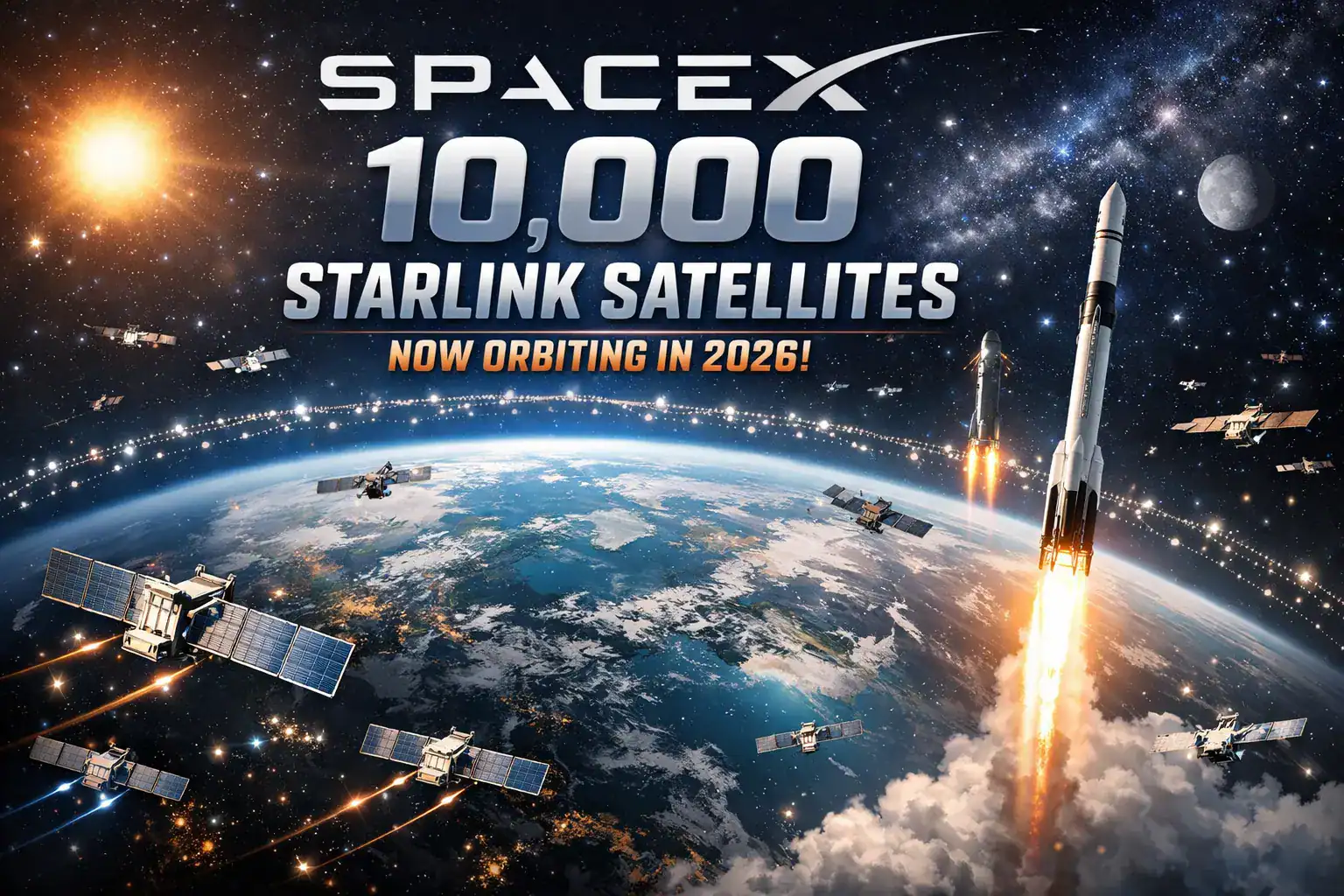
In a defining moment for commercial spaceflight, SpaceX has crossed a remarkable threshold the company now has more than 10,000 active Starlink satellites simultaneously orbiting Earth, cementing its position as the undisputed leader of the global launch industry. The milestone arrived quietly but powerfully, following a relentless string of Falcon 9 rocket launches in mid-March 2026 that had space enthusiasts and industry watchers buzzing across the globe.
The Launch That Made History
The milestone mission, dubbed Starlink Group 17-24, lifted off at 10:19 p.m. PDT on March 16 (1:19 a.m. EDT on March 17) from Space Launch Complex 4 East at Vandenberg Space Force Base in California. The Falcon 9 rocket, carrying 25 Starlink V2 Mini Optimized satellites, soared into a southerly orbit and with that single launch, SpaceX officially pushed past the 10,000-satellite mark in its Starlink constellation.
The first stage booster completed its 14th flight and touched down on the drone ship “Of Course I Still Love You” in the Pacific Ocean, marking the 184th landing on that vessel and the 586th booster landing in SpaceX history.
Just hours later, SpaceX wasn’t done. A second Falcon 9 rocket carrying another 29 Starlink satellites lifted off from Space Launch Complex 40 in Florida at 9:27 a.m. EDT on March 17. That booster completed its 11th flight and landed on the drone ship “A Shortfall of Gravitas” in the Atlantic Ocean. The Florida launch marked SpaceX’s 34th Falcon 9 mission of the year and the 378th Starlink launch in the company’s history.
Two launches. Two coasts. One extraordinary day for humanity’s space age.
What Is the Starlink Constellation?
Starlink is SpaceX’s ambitious satellite internet project, designed to deliver high-speed broadband connectivity to every corner of the globe from remote villages in developing nations to maritime vessels crossing open oceans. Founded in 2002 with the ultimate goal of enabling people to live on other planets, SpaceX has since built a self-sustaining revenue engine in the form of Starlink, which now funds its interplanetary ambitions.
The Starlink V2 Mini Optimized satellites are equipped with Direct-to-Cell technology, allowing smartphones to connect directly to Starlink satellites without any specialized hardware a feature that has drawn attention from major telecom operators worldwide. SpaceX aims to complete over 150 launches in 2026, with frequent Starlink flights necessary to maintain the constellation’s health and roll out Direct-to-Cell capabilities globally.
A Launch Cadence Like No Other
SpaceX’s dominance in the global launch market in 2026 is nothing short of staggering. In the first two months of 2026 alone, SpaceX completed over 25 launches, including the record-breaking 600th Falcon 9 flight and the successful docking of Crew-12 at the International Space Station.
The Falcon 9 has now achieved over 620 successful launches, with individual boosters reaching 30 or more flights, drastically reducing the cost per kilogram to orbit. Most Starlink missions now utilize “highly-flight-proven” boosters. This reusability model has transformed the economics of space access and placed competitors years behind SpaceX in launch frequency.
SpaceX has maintained an almost weekly sometimes daily launch cadence from both Vandenberg Space Force Base in California and Cape Canaveral Space Force Station in Florida, operating on two coasts simultaneously to keep up with the staggering demand.
What’s Next: Starship V3 on the Horizon
While Falcon 9 continues to be the workhorse of the SpaceX fleet, the spotlight is increasingly shifting to Starship the most powerful rocket ever built.
SpaceX is expected to start launching its much larger Starlink Version 3 satellites using the massive Starship rocket this year, though no public launch date has been confirmed as the company continues testing and refining the Starship V3 vehicle.
Industry analysts forecast as many as eight Starship launches carrying Starlink satellites during 2026. The V3 version of Starship is expected to lift 100 metric tons to orbit, and paired with the V3 satellite which will carry a terabit of data capacity it would deliver far greater capability than any other low Earth orbit satellite currently in operation.
Starship V3 features upgraded Raptor 3 engines with no external plumbing and increased propellant capacity, aiming for a total payload of over 100 tons to low Earth orbit. If achieved, this would represent a quantum leap in the volume of internet capacity SpaceX can deliver from orbit.
Upcoming SpaceX Launches to Watch
Looking ahead, SpaceX has several upcoming Falcon 9 missions from both Cape Canaveral and Vandenberg Space Force Base, including a Transporter-16 SmallSat rideshare mission scheduled for March 29 that will deploy dozens of microsatellites for global customers.
Additionally, NASA’s Commercial Resupply Services mission – a Cargo Dragon flight to the International Space Station – is on the manifest for no earlier than May 2026, bringing critical supplies and scientific payloads to directly support research investigations aboard the orbiting laboratory.
Why This Milestone Matters
The 10,000-satellite milestone is more than a number – it represents the emergence of a new layer of global infrastructure, built not by governments but by a private company. Starlink is currently active in dozens of countries, serving millions of users, military customers, airlines, and maritime operators.
SpaceX’s operational dominance rests on three pillars: Falcon 9’s near-weekly launch cadence from both coasts, the transition to Starship V3 for high-capacity orbital missions, and continued Artemis program participation as SpaceX’s Human Landing System development remains a top priority for NASA’s crewed lunar ambitions.
For a company that launched its first rocket only two decades ago, placing 10,000 satellites into orbit while simultaneously developing the world’s most powerful rocket is an achievement without precedent in the history of spaceflight.
Also Read: Crude Oil Price Crisis 2026: Why India Is Watching Every Dollar