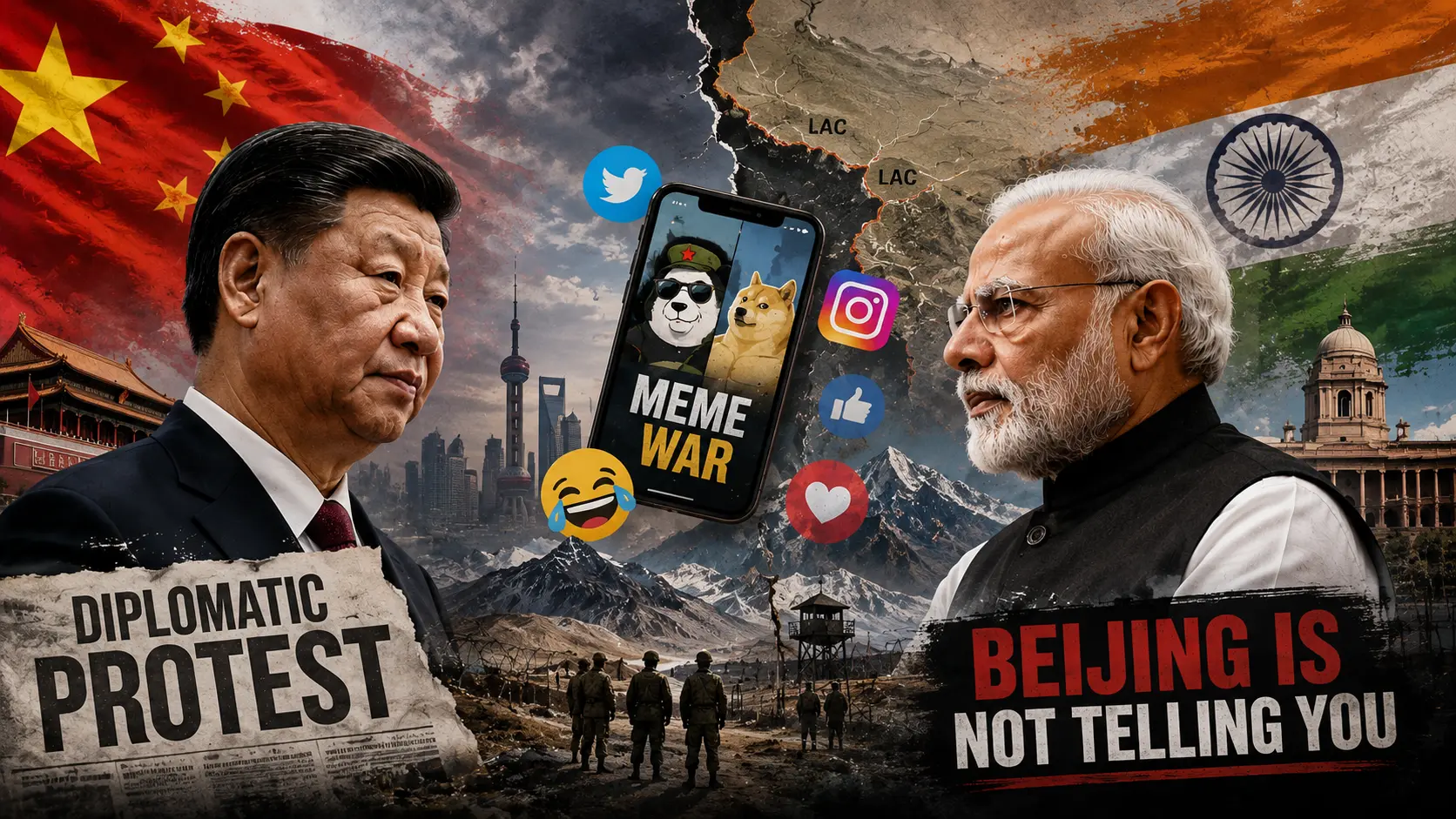
Something unusual happened this week. Global Times, the official mouthpiece of the Chinese Communist Party, ran a full editorial responding to memes posted by ordinary Indian citizens on social media. Not a government statement. Not a diplomatic cable. Memes. The fact that Beijing’s state propaganda machinery felt the need to formally respond tells you everything about who landed the harder blow in this viral exchange.
The backdrop: Indian users on X began circulating content pointing to China’s ancient Shi-Nong-Gong-Shang social hierarchy, a four-tier occupational ranking system dating to the Zhou Dynasty nearly 3,000 years ago. The memes arrived as a sharp counter-offensive to weeks of Chinese users mocking India’s caste system, hygiene, and living standards. The internet war had been running for weeks. India’s response stopped it cold.
“When a state propaganda organ dignifies anonymous internet memes with an official editorial rebuttal, it is not controlling the narrative. It is confirming that the memes worked.”
THE QUESTION EVERYONE IS ASKING
Was India’s Ambassador Summoned by Beijing?
Claims circulating on X suggest Beijing formally summoned India’s ambassador and filed a diplomatic protest over the caste meme campaign. Neither India’s Ministry of External Affairs nor China’s Ministry of Foreign Affairs has confirmed any such summons on record. No major news agency has independently verified the claim. What is verifiable, however, is that China’s state media went on official record attacking the Indian meme campaign within 24 hours of it going viral.
In diplomatic terms, that distinction matters less than it might appear. A formal summons would have required Beijing to officially acknowledge that anonymous Indian social media posts constitute a national concern worth escalating. China was never going to do that publicly. The Global Times editorial was the calculated alternative: push back without creating a formal diplomatic paper trail that grants the memes the status they clearly already achieved.
WHAT IS CONFIRMED AND WHAT IS NOT
- Global Times (Chinese state media) published an official editorial on June 18, 2026 calling Indian memes a display of ignorance about Chinese history. This is confirmed.
- No official diplomatic summons of India’s ambassador has been confirmed by MEA, China’s MFA, or any credible newswire. The viral claim on X lacks a verifiable source.
- China’s hukou household registration system, referenced in many Indian memes, is a documented and functioning policy that creates real two-tier citizenship inequalities in present-day China.
- The Shi-Nong-Gong-Shang ranking Indian memes referenced is a real historical framework from the Zhou Dynasty; unlike India’s jati and varna traditions, it was occupational rather than hereditary – a distinction Global Times correctly pointed out.
THE MEME CAMPAIGN
How Indian Users Turned China’s Own Playbook Back on Beijing
For weeks before the meme counter-offensive, Chinese users had been weaponising India’s caste history as a blunt instrument of mockery across platforms including X and Weibo-linked accounts. The attacks were not nuanced. They did not engage with India’s social reform movements, constitutional protections, or the significant social mobility visible in modern Indian institutions. They were simply used as a one-line dismissal of India as a society.
Indian users responded by applying the identical framework to China. The Shi-Nong-Gong-Shang system, which placed scholars and officials at the top and merchants at the bottom, was presented as China’s equivalent social hierarchy. The hukou system, which restricts an estimated 300 million rural Chinese citizens from accessing the same education, healthcare, and economic opportunities available to urban residents based on their place of registration – was highlighted as evidence that hierarchical social stratification is not a uniquely Indian phenomenon. While Beijing has announced reform measures and claims over 40 million rural migrants obtained urban hukou between 2021 and 2023, the two-tier structure remains functionally intact for the vast majority of the migrant population.
THE POINT WAS NOT ACADEMIC PRECISION. IT WAS SYMMETRY. AND IT LANDED.
“ China’s hukou system restricts an estimated 300 million rural migrants from accessing urban public services based on their place of birth registration. Beijing has announced reforms, but the structural inequality remains in force for the vast majority. That is not ancient history. That is 2026.”
THE STATE MEDIA TELLS
Why Beijing’s Response Reveals More Than It Intended
The Global Times editorial framed the Indian meme campaign as a reflection of ignorance about Chinese cultural history. This framing deserves scrutiny. China’s state media does not expend editorial resources rebutting content it considers genuinely irrelevant. The decision to run an official piece on Indian memes signals that Beijing’s information managers considered the content damaging enough to require a response.
The editorial also chose to engage primarily with the Shi-Nong-Gong-Shang angle, arguing it was occupational rather than hereditary and therefore not comparable to caste. What it did not address was the hukou dimension of the meme campaign, which points to a living, present-day inequality mechanism rather than an ancient classification system. That omission is as telling as the response itself.
India’s Ministry of External Affairs has not commented, and has no obligation to. The meme campaign was driven by Indian citizens exercising free expression, not by any government actor. That is a distinction Beijing is structurally incapable of making credibly about its own population’s online behaviour.
The Bottom Line
The ambassador summons claim circulating on X is unverified and likely fabricated as viral amplification of a real underlying conflict. What is real is that India’s citizen-driven meme campaign prompted an official Chinese state media response within 24 hours, while weeks of Chinese users mocking India produced no equivalent official Indian government reaction. That asymmetry is the actual story. India’s free and uncoordinated internet culture achieved what no diplomatic cable could: it made China’s propaganda apparatus feel compelled to respond. Beijing does not do that for content it is not worried about.
Context
This Meme War Is Not Noise. It Reflects Something Real.
The India-China social media troll cycle is not spontaneous. It mirrors genuine bilateral friction across the Line of Actual Control, trade asymmetries, technology competition, and strategic rivalry across the Indo-Pacific. Indian users expressing frustration through meme culture and Chinese state media responding through official editorial channels are both symptoms of the same structural tension, not separate phenomena.
India does not have a Ministry of Memes. China does not need one because it has Global Times. The difference in how both countries handle online nationalist expression tells you something important about the nature of the two political systems that no diplomatic summons, real or fabricated, could illustrate more clearly.