
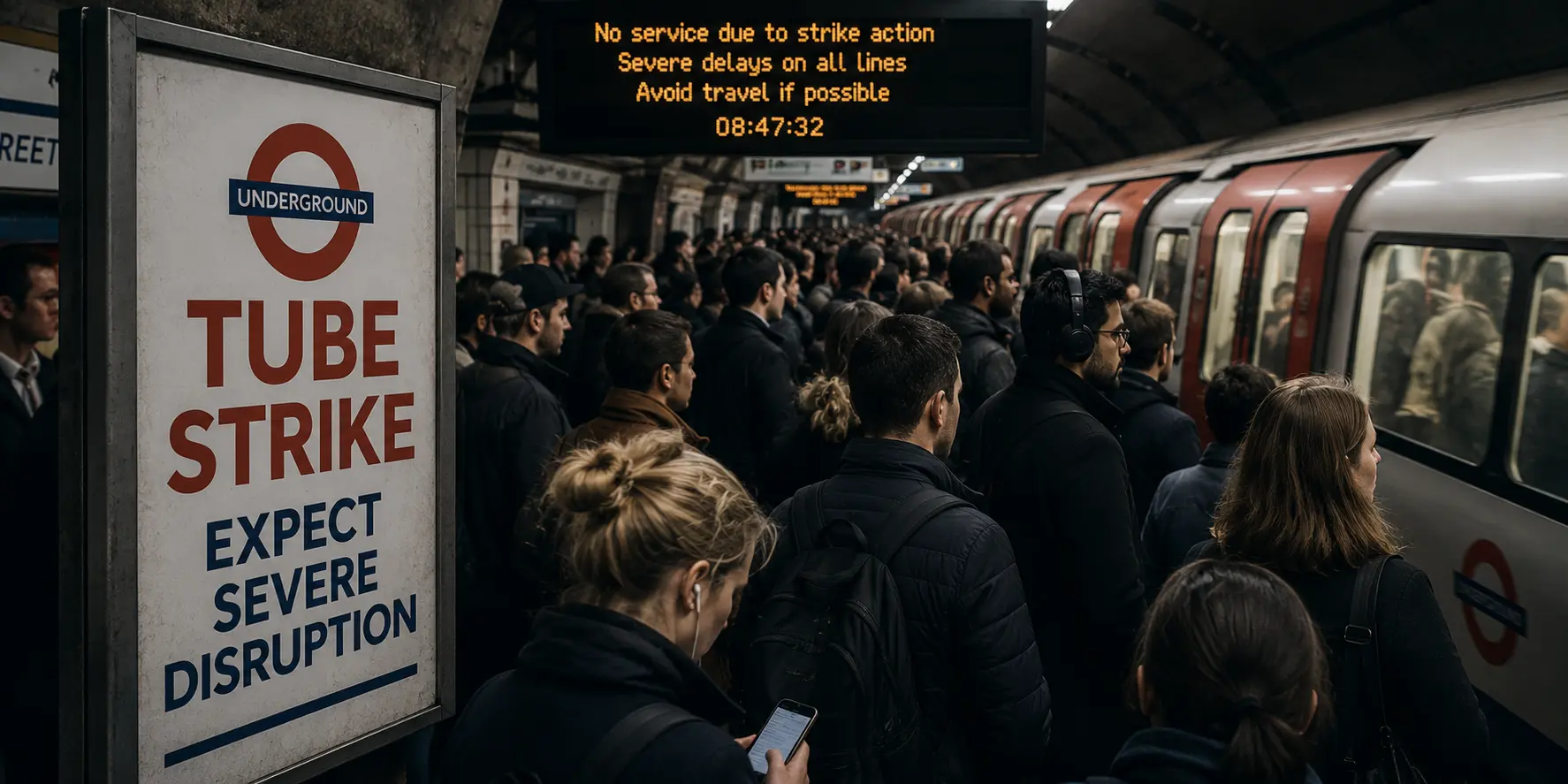
The dread is back. After weeks of last-minute reprieves, London commuters have run out of luck. Tube drivers are walking off the job this week, and millions of journeys across the capital are about to get a lot harder. If you rely on the Underground to get to work, school, or the airport, here is exactly what is happening, why, and how to keep moving when the trains do not.
When Are the London Tube Strikes in June 2026?
The RMT union has confirmed two separate 24-hour walkouts by London Underground drivers. The first runs all day on Tuesday June 2, and the second hits on Thursday June 4. Each strike covers the full day from just after midnight to 11:59pm.
The knock-on effect spills into the mornings after. Transport for London has warned that disruption is also likely on the mornings of Wednesday June 3 and Friday June 5 as the network slowly returns to normal service.
This is the pattern Londoners have come to fear. London Tube Strikes planned for May 19 and 21 were called off at the eleventh hour, and a separate pair set for June 16 and 18 were also abandoned. But the talks meant to stop this week’s action collapsed, and the RMT confirmed the walkout would go ahead after TfL, in the union’s words, refused to engage meaningfully with its concerns.
Which Tube Lines Are Affected by the Strikes?
Here is the small mercy: this is not a total shutdown. Drivers belonging to the ASLEF union are not taking part, and non-driver RMT members are not walking out either. That means TfL expects to run a reduced service on many lines rather than closing the network completely.
Still, do not expect a smooth ride. TfL has warned of disruption across the entire network, with some lines hit far harder than others. Service before 06:30 is expected to be very limited on both strike days, and TfL is urging passengers to complete their journeys before 21:00.
Crucially, the Elizabeth line, the London Overground, and the DLR are not part of the London Underground network and are expected to keep running. They will be far busier than usual, but they remain your best bet for getting across town.
Why Are London Underground Workers Striking?
At the heart of the dispute is a proposed compressed four-day working week for Tube drivers. The plan would let drivers fit their hours into four days instead of five.
The RMT says that squeezing a full week into four days means longer shifts, and the union has raised serious alarm over fatigue, reduced flexibility, and safety risks in a role where concentration is everything. An RMT spokesperson summed up the mood, saying the dispute is not over and more action will follow without real progress.
The friction goes back months. RMT members voted for action in February, walkouts went ahead in April, and the rolling threat has hung over the city ever since.
What TfL Says About the Four-Day Week
Transport for London tells a very different story. Its position is that the four-day week is completely voluntary and was designed to improve work-life balance, not to pile on extra hours. TfL insists the change would not increase drivers’ contractual hours, and that anyone who prefers the traditional five-day pattern can keep it.
TfL’s chief operating officer Claire Mann said the operator was disappointed by the action and believes the issues can still be resolved through more detailed talks. She added that TfL is continuing to speak with union representatives to try to spare London the disruption.
How to Get Around London During the Tube Strikes
You have more options than you might think. With the Underground crippled, the buses, National Rail, the Overground, the Elizabeth line, and the DLR will all be running and picking up the slack. They will be crowded, so leave earlier than usual and build in extra time.
E-bike and cycle hire schemes tend to be wildly popular on strike days, so grab one early if that is your plan. Walking shorter central journeys is often faster than waiting for a packed bus.
Heading to the airport? If the Piccadilly line is your usual route to Heathrow, switch to the Elizabeth line or the Heathrow Express, both of which should run as normal. Coach services from operators like National Express also link central and outer London to the major airports.
Will There Be More Tube Strikes After June?
Possibly. The current round of action is set to run until June 5, but the underlying dispute is far from settled. The RMT has made clear that further strikes could be called if it cannot reach agreement with TfL.
There is also a bigger backdrop. Earlier this year the government scrapped a rule that had required a minimum level of support in strike ballots for key public services, a change that makes industrial action easier to mount.
For now, the advice is simple. Check the live TfL status before you set off, plan an alternative route, and give yourself far more time than usual. London has weathered tube strikes before, and the city always finds a way to keep moving, even if it has to do it on foot.