
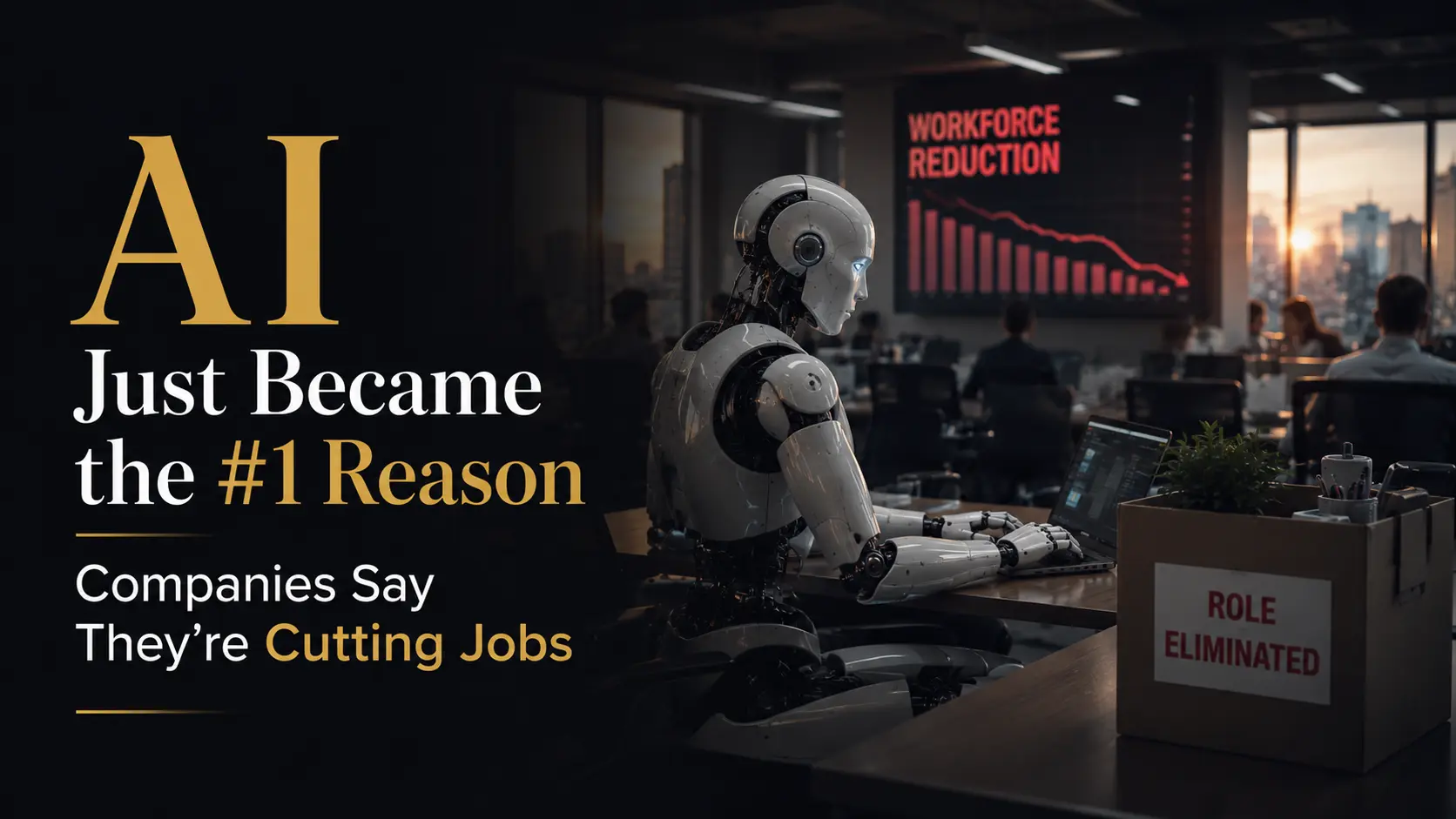
For the first time since it started tracking layoffs, outplacement firm Challenger, Gray & Christmas reported this spring that AI had become the single most common reason U.S. employers gave for cutting jobs. Not “restructuring.” Not “market conditions.” AI, stated outright, in the paperwork.
Why it matters: AI-attributed layoffs hit 87,714 in just the first five months of this year. That already blew past the 54,836 recorded for all of 2025. This isn’t a slow trend anymore. It’s accelerating.
The companies making the cuts
IBM replaced roughly 200 HR positions with AI agents in a fourth-quarter restructuring, even while telling Bloomberg it plans to triple its U.S. entry-level hiring for AI and hybrid-cloud roles. Salesforce shrank its customer support division from 9,000 employees to about 5,000 after deploying AI agents the company says now handle half of all customer interactions.
Amazon cut 16,000 corporate jobs in January, citing AI investment priorities. Meta cut roughly 8,000 in a similar wave, timed alongside a massive AI infrastructure buildout. Accenture eliminated about 11,000 jobs last September as part of an $865 million restructuring; CEO Julie Sweet told investors AI has become part of everything the company does, and that some roles simply couldn’t be reskilled fast enough.
Who’s actually losing their jobs
Two groups are absorbing most of the damage, and it’s not an even split by seniority.
The first is workers just starting out. Junior analyst roles, first-line customer support, entry-level coding and writing jobs, exactly the positions that have always served as the first rung on a career ladder, are declining fastest in the hiring data. A Stanford study found a 13% drop in entry-level employment specifically in AI-exposed fields. A separate SignalFire report found a 25% decline in entry-level tech hiring at Meta, Microsoft and Google between 2023 and 2024 alone.
The cruel irony: the workers most comfortable using AI tools are the ones getting locked out of the jobs that would have taught them to use those tools professionally.
The second group is experienced, mid-career employees in roles built around routine execution. Forrester’s 2026 workforce research flags a quieter risk here, not replacement exactly, but disengagement, as people watch colleagues get cut for AI capabilities that don’t always match the efficiency claims companies made when announcing the cuts.
Real AI, or just cover for cuts?
Not every “AI layoff” is actually AI doing the work. Klarna is the industry’s favorite cautionary tale: in 2024 it announced its AI system was doing the work of 700 customer service agents. By 2025, it was quietly rehiring customer service staff after the technology hit real limits nobody advertised as loudly as the original claim.
OpenAI CEO Sam Altman has said companies increasingly treat AI agents like “junior employees”, assigning tasks, reviewing output, giving feedback, rather than humans doing the underlying work directly. Anthropic CEO Dario Amodei went further, telling Axios that AI could wipe out half of all entry-level white-collar jobs within one to five years. He acknowledged it sounds extreme. He said he believes it anyway.
The bottom line: The Bureau of Labor Statistics expects computer programmer jobs to shrink 6% over the next decade because of AI automation, even as demand grows for people who build and manage AI systems. The job market isn’t just shrinking. It’s splitting, and the entry point is where it’s splitting hardest.
What workers can actually do about it
Labor economists say the practical distinction, real AI replacement versus AI used as cover for cuts driven by slowing growth, matters less to an individual worker than it might seem. Either way, the job is gone, and the skills now in demand tend to sit on the side of building or overseeing AI systems rather than performing the routine tasks those systems increasingly handle.
The World Economic Forum’s sector analysis projects roughly 92% of IT jobs will be substantially transformed within five years, a figure that captures how broadly this reaches even into the industry building the technology itself. Amazon CEO Andy Jassy told employees last year that generative AI and agents would mean the company needs “fewer people doing some of the jobs that are being done today,” a rare moment of a tech CEO saying the quiet part out loud, on the record, to his own workforce.