
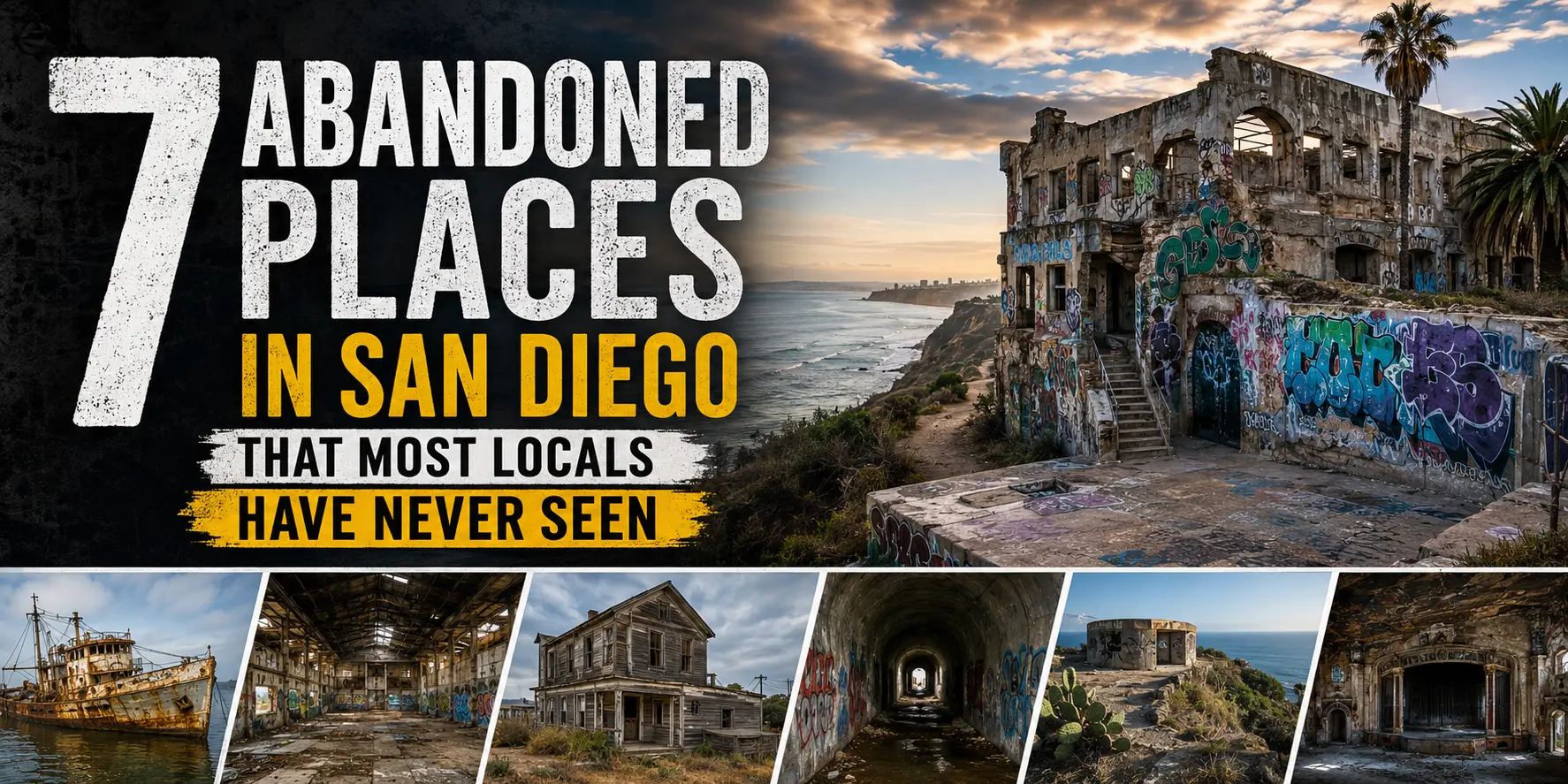
San Diego sells itself as beaches and perfect weather, but a short drive inland or a walk to the right downtown corner tells a harder story. Gold ran out. A railroad lost a fight with the desert. The military packed up after the war. A movie palace that once called itself a cathedral was simply locked and left. These are the most striking abandoned places in San Diego, with the real history of each, the current condition, and the part most lists skip: whether you can actually, legally go.
Why San Diego Has So Many Abandoned Places
The county is bigger and stranger than the coastline suggests. East of the city it climbs into the Cuyamaca and Laguna mountains, then drops into the Anza-Borrego desert, terrain that swallowed gold camps, stage stations, and an entire railroad. Closer in, ordinary economics did the work: a theater that could not compete with multiplexes, an amusement park that went bankrupt, a fort that lost its purpose. The result is a spread of abandoned places in San Diego that runs from Spanish-colonial ruins to a building that was still showing films within living memory.
1. Goat Canyon Trestle: The Desert’s Great Abandoned Railroad
Deep in the Carrizo Gorge near Jacumba stands the largest wooden railroad trestle in the world, curving roughly 200 feet above a desert ravine and going absolutely nowhere. It belongs to the San Diego and Arizona Eastern Railway, the line so brutal to build that crews nicknamed it the “Impossible Railroad.” Opened in 1919 after punching 17 tunnels and 14 trestles through the gorge, the route met its match in 1932 when an earthquake collapsed Tunnel 15. Rather than rebuild underground, engineers threw the Goat Canyon Trestle across the open canyon, framing it in redwood specifically because the wood handled the gorge’s extreme temperature swings better than steel.
Nature kept fighting. In 1976 a rare tropical storm, Hurricane Kathleen, tore through the gorge, wrecking tunnels and trestles, and the line’s owner moved to abandon it rather than rebuild. Today the trestle stands unused. Reaching it is a serious undertaking: a strenuous, waterless desert route often cited at around 16.5 miles round trip, through pitch-dark tunnels and across terrain with no rescue services and real flash-flood risk. Critically, the rail corridor is still private property. Visitors are advised to keep a buffer of about 100 feet from the structure to avoid a trespassing citation, and the tunnels themselves should not be entered.
2. Stonewall Mine: San Diego’s Gold-Rush Ghost Town
In March 1870, a farmer named William Skidmore reportedly stumbled onto a ledge of gold-bearing quartz in the Cuyamaca Mountains while chasing a runaway mule. Within hours, the story goes, hundreds of men were digging. What grew from that became the Stonewall Mine, the most productive gold mine in San Diego County’s history, yielding an estimated two million dollars in gold over its life. The shaft eventually reached about 600 feet deep, and a boomtown called Cuyamaca City sprang up alongside it, peaking near 500 residents with a hotel and boarding houses. The mine, at one point owned by California Governor Robert Waterman and managed by his son Waldo, closed in January 1892 as ore declined and flooding in the shaft became impossible to control.
Today the site sits at the northern end of Cuyamaca Rancho State Park, open to the public daily with a parking lot, restrooms, picnic tables, and interpretive markers laid over the old foundations. It is one of the few abandoned places in San Diego you can visit casually, no permit or scramble required, and walk the footprint of a vanished town.
If the boom-and-bust pattern grabs you, the same story plays out on a far larger scale across the state line. See our companion guide to the abandoned places in Colorado, where entire mining towns sit frozen at 11,000 feet.
3. Point Loma’s WWII Bunkers: Abandoned Buildings in San Diego With a War Story
The Point Loma peninsula rises 422 feet over the entrance to San Diego Bay, which made it a natural fortress. The United States set the land aside as a military reserve in 1852, and the War Department dedicated Fort Rosecrans there in 1899, naming it for a Civil War general. Between 1918 and 1943, spanning both World Wars, the Army layered the headland with gun batteries, searchlight bunkers, and base end stations, the small concrete observation posts used to triangulate the range to enemy ships out at sea.
Many of these abandoned buildings in San Diego survive, and the most accessible cluster sits within Cabrillo National Monument, where a restored bunker and base end station are open to visitors and tied to the park’s coastal-defense exhibits. Be aware of the split: a good number of the old emplacements lie on active Navy property and are strictly off limits. Stick to the monument’s marked sites and you can stand inside genuine wartime concrete with a straight view down the harbor the guns once guarded.
4. The California Theatre: The Most Famous of San Diego’s Abandoned Buildings
On a downtown corner at Fourth and C stands the most photographed of San Diego’s abandoned buildings, a 1927 movie palace once billed as a “cathedral of motion pictures.” The California Theatre ran films until 1976 under Mann Theatres, limped on as a concert venue, and finally went dark in 1990, the same year it landed on the city’s register of historical resources. That listing has not saved it. For roughly 35 years it has stood vacant, breached by trespassers and damaged by fires set inside, while its grand Wurlitzer organ, removed after closing, was itself later destroyed by arson at the church that took it.
The endgame is now legal rather than romantic. Australia-based Caydon Property Group bought the property in 2019, and in 2025 a court order required the owners to put the building up for sale or face a deadline to close and demolish it. The structure is fenced, structurally compromised, and actively patrolled as a public-nuisance site, so this is one to photograph from the public sidewalk only, not to enter.
5. Marshal Scotty’s Playland: An Abandoned Place in San Diego Frozen in 1998
In El Cajon’s eastern hills sit the rusting bones of Marshal Scotty’s Playland, a family amusement park that opened in 1967 under the slogan “You’ll never want to leave.” For a few decades it delivered exactly the modest fun a kid wanted: a small roller coaster, a 20-foot Ferris wheel, a tilt-a-whirl, bumper cars, a “Bulgy the Whale” ride, and a railroad. In 1989 an ambitious owner sank around half a million dollars into a go-cart track and one of the longest water slides in Southern California, betting on a water-park future that never arrived. A bankruptcy filing followed, the park changed hands and names, and it shut for good in 1998.
It has decayed ever since, and it carries an important caveat among abandoned places in San Diego: the lot is privately owned, fenced, and people actually live on the property, so casual exploring is trespassing. The one sanctioned way in arrived in 2015, when operators began running the grounds as a seasonal “Haunted Amusement Park” scare trail each October, turning the genuine ruin into the set.
6. Vallecito Stage Station: A San Diego Ghost Town on the Old Overland Trail
Out on the edge of the Anza-Borrego desert, Vallecito County Park preserves a relic from before the railroads: a Butterfield Overland stage station established in the 1850s, when this spot was a vital waypoint offering fresh horses, food, and a last taste of shelter to travelers crossing the desert between San Diego and the East. The squat sod-and-stone building you see today is a 1930s reconstruction of that station, set on 71 acres ringed by Kumeyaay land and state desert wilderness.
It has earned a reputation as one of the more haunted abandoned places in San Diego County, complete with a small hilltop cemetery and the local legend of a “Lady in White.” Practically speaking, it is a quiet, primitive campground with about 44 sites and some of the darkest night skies in the region. Note the season: the park is typically open from Labor Day weekend through the end of May and closes for the brutal desert summer.
7. Old Mission Dam: One of the Oldest Abandoned Places in San Diego
Not every ruin here comes from the mining or movie era. In Mission Trails Regional Park, about 12 miles from downtown, sits the Old Mission Dam, also called the Padre Dam, built between roughly 1803 and 1816 by Franciscan missionaries and Kumeyaay laborers. It was constructed to impound the San Diego River for Mission San Diego de Alcalá, the first Spanish mission in California, and it counts as the first major colonial-era irrigation project on the entire Pacific coast of the United States. The dam ran about 220 feet long, 13 feet wide at the base, and 12 feet high, feeding a tile-lined flume that carried water some five miles downstream to the mission’s fields.
After the missions were secularized in 1833 the dam fell into disrepair, and by 1867 it was largely in ruins. The flume is long gone, but the stone dam remnant still stands and still holds a quiet pool of river water behind it. Designated a National Historic Landmark in 1963, it is now an easy, wheelchair-accessible stop and a trailhead, making it the most effortless way to put your hand on a two-century-old ruin in the county.
How to Explore Abandoned Places in San Diego Safely and Legally
The single most important rule with these abandoned places in San Diego is that “abandoned” rarely means “open.” Several of the best sites here are firmly off limits: the California Theatre is fenced and treated as a nuisance property, Marshal Scotty’s is private land with residents on it, parts of the Point Loma defenses sit on an active Navy base, and even the Goat Canyon rail corridor is private, with a recommended 100-foot buffer to avoid a citation. Stick to the ones built for visitors when you want to get close, namely Stonewall Mine, Old Mission Dam, the Cabrillo bunkers, and Vallecito. Respect the desert: the eastern county routes are waterless, shadeless, and prone to flash floods, so carry far more water than you think you need and check the season and weather first. Never enter old tunnels or mine openings, which can collapse, flood, or hold bad air. And whatever you visit, take only photos and leave every structure exactly as you found it, so the next person gets the same first look you did.