
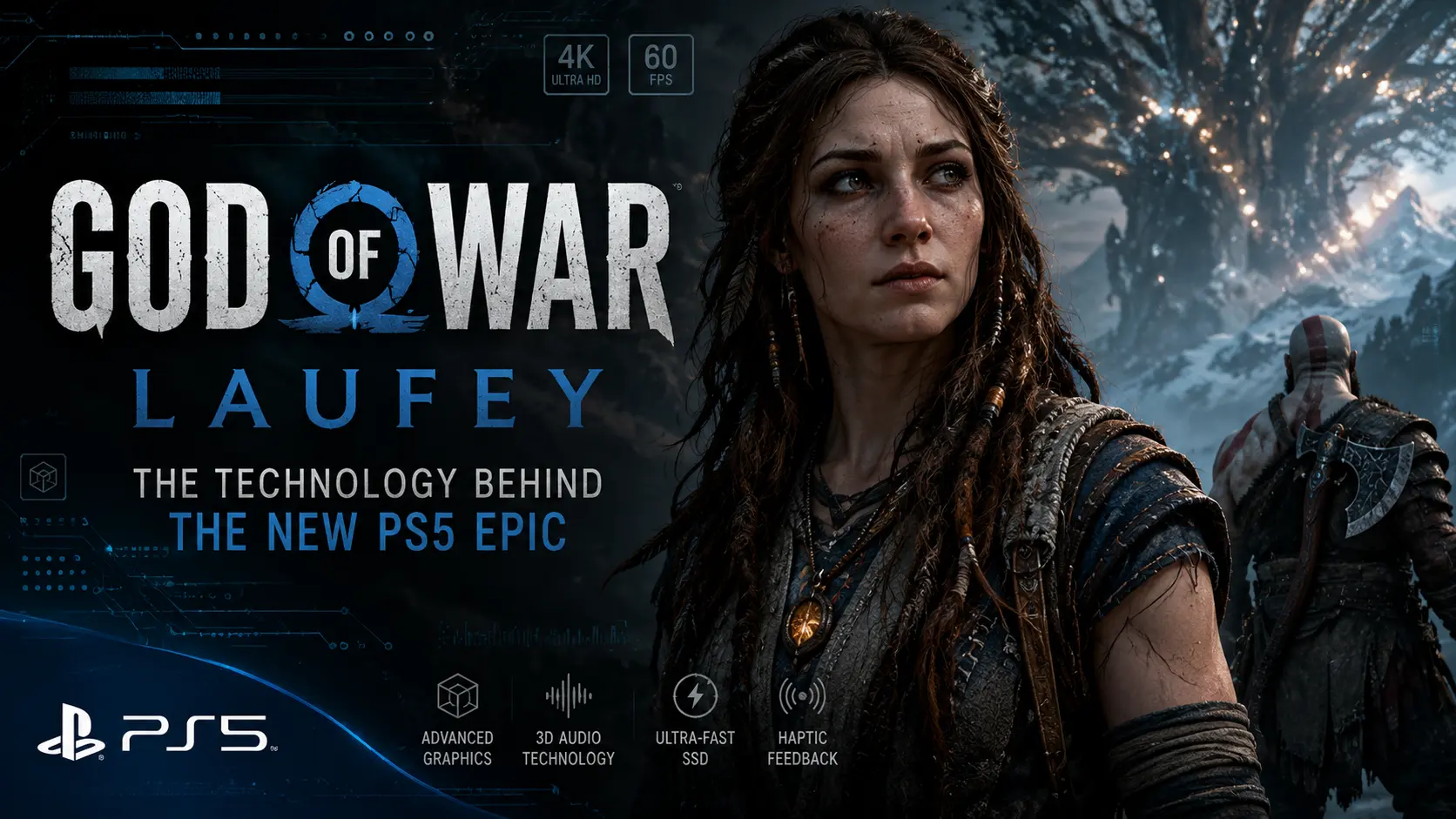
When Sony closed out its June 2026 State of Play, it did so with a reveal that instantly dominated search trends: God of War Laufey. The next mainline entry in PlayStation’s flagship franchise puts Faye – Kratos’ wife and Atreus’ mother – at the center of her own story for the first time. But beyond the announcement hype, God of War Laufey is a showcase of the technology that makes a modern PlayStation 5 blockbuster possible. This article breaks down the engine, rendering, audio, and hardware innovations expected to power Faye’s journey, and explains why God of War Laufey matters as much for game technology as it does for the story.
Table of Contents
ToggleWhat Is God of War Laufey?
God of War Laufey is the new action-adventure game from Santa Monica Studio, the team behind God of War (2018) and God of War Ragnarök. Rather than following Kratos, the game stars Laufey – known by her alias Faye, a Jötunn warrior whose legend shaped the Nine Realms long before she met Kratos.
The premise is bold: death is not the end. Faye awakens in “the Everywhen,” the afterlife of the gods, where deities from many mythologies struggle for power. Players will encounter figures pulled from beyond the Norse canon, including the Egyptian goddess Sekhmet and the Tibetan protector Begtse. Deborah Ann Woll returns to voice Faye, with Santa Monica’s Cory Barlog as Head of Creative and Ariel Lawrence as Game Director. The game is confirmed for PlayStation 5 and listed as “coming soon,” with no firm release date yet.
A Proprietary Engine Built for Scale
The single biggest piece of technology behind God of War Laufey is one most players never see: Santa Monica Studio’s in-house game engine. Unlike studios that license Unreal or Unity, Santa Monica has long developed its own proprietary engine specifically tuned for the God of War series. That control lets the team build bespoke systems – combat, physics, and world-streaming – exactly to the needs of each game rather than bending a third-party toolset to fit.
This matters for Laufey because the Everywhen is described as a sprawling, multi-mythology realm. Rendering wildly different art styles – Norse ruins, Egyptian iconography, and ethereal “in-between” spaces – in a single seamless world demands a flexible, modular pipeline. Santa Monica’s engineers have publicly discussed building rendering systems in modular pieces, an approach that paid off on Ragnarök when the team reused its advanced snow technology to power entirely different effects. Expect that same philosophy to drive Laufey’s varied environments, with reusable systems handling everything from volumetric fog to dynamic surface interaction.
Ray Tracing, Lighting, and the Look of the Everywhen
Lighting is where God of War Laufey is likely to make its strongest technical statement. The PS5’s RDNA 2-based GPU supports hardware-accelerated ray tracing, and the franchise’s recent push toward “filmic” visuals makes Laufey a natural candidate for ray-traced reflections and more physically accurate global illumination.
The Everywhen’s premise – a realm where magic itself originates and returns – practically invites a lighting-driven art direction. Reveal footage already emphasized atmospheric, lushly rendered ruins and dramatic light sources cutting through gloom. Achieving that look at scale relies on a stack of modern techniques: physically based rendering for realistic materials, high-quality shadow mapping, screen-space and possibly ray-traced reflections, and volumetric lighting to give the air itself a tangible presence. Combined with the studio’s signature use of color and contrast, this lighting technology is what transforms a polygon environment into a place that feels mythic.
The “One-Shot” Camera and Seamless Streaming
A defining technical hallmark of modern God of War games is the unbroken “one-shot” camera – the entire game plays out without a single visible cut, from cutscene to combat to exploration. Pulling this off is far harder than it sounds. There are no loading screens to hide asset streaming behind, so the engine must continuously load and unload the world around the player in real time, all while keeping the camera glued to the character.
This is where the PS5’s custom solid-state drive becomes essential to God of War Laufey. The console’s high-speed SSD and dedicated decompression hardware let the engine stream massive amounts of geometry and textures on demand, feeding the one-shot camera without hitches. If Laufey moves between radically different mythological zones within the Everywhen, that streaming bandwidth is what makes those transitions feel instantaneous rather than gated behind a door or an elevator ride.
DualSense, Tempest 3D Audio, and Immersion
Visuals get the headlines, but God of War Laufey will live or die on feel and that is increasingly a hardware story. The PS5’s DualSense controller brings adaptive triggers and high-fidelity haptic feedback, and the God of War series has used these to make every axe throw and shield bash carry physical weight. For Faye, whose combat is described as fast, controlled, and relentless, expect haptics tuned to the rhythm of her blade and adaptive-trigger resistance that communicates the strain of heavier abilities.
Audio is the other half of immersion. Sony’s Tempest 3D AudioTech delivers object-based spatial sound, placing enemies, magic, and environmental cues precisely around the player. In a realm as disorienting as the Everywhen – full of gods you cannot see coming – convincing 3D audio is not a luxury but a core gameplay system, helping players track threats and read the space by ear.
Performance Modes: Fidelity vs. 60 FPS
Like its predecessors, God of War Laufey is almost certain to ship with selectable performance modes. The series has consistently offered a Resolution/Fidelity mode targeting higher detail and a Performance mode prioritizing a smooth 60 frames per second, often using techniques like checkerboard or temporal upscaling to balance image quality against framerate.
On PS5 Pro, the picture gets even more interesting. Sony’s PSSR (PlayStation Spectral Super Resolution) machine-learning upscaler – already used by other flagship titles – could let Laufey deliver near-fidelity image quality at high framerates by reconstructing detail from a lower internal resolution. For players, that means the choice between cinematic crispness and responsive, fluid combat, with AI upscaling increasingly erasing the trade-off between the two.
Why Laufey Matters for PlayStation’s Tech Roadmap
God of War Laufey is more than a sequel; it is a flagship demonstration of what Santa Monica’s engine and the PS5 platform can do this generation. First-party Sony titles double as showcases that push the hardware and set expectations for the wider industry. Every technique Laufey refines – streaming for the one-shot camera, ray-traced lighting for the Everywhen, ML upscaling on PS5 Pro – feeds back into PlayStation’s broader technical playbook.
For fans, that translates into a simple promise: a God of War game that looks and feels like nothing before it. For the industry, God of War Laufey is a reminder that the most memorable worlds are built on invisible engineering.
It also explains why the hardware race matters on every platform. A new wave of silicon like the Nvidia RTX Spark, with its Blackwell-based GPU rated to run modern games at 1440p above 100fps is engineered for exactly these kinds of demanding upcoming games, the graphically ambitious worlds that need next-generation rendering power to run at their best.
The Bottom Line
God of War Laufey brings Faye to the forefront in a mythic afterlife adventure exclusive to PS5 and the technology underneath is every bit as ambitious as the premise. From Santa Monica Studio’s proprietary engine and ray-traced lighting to SSD-powered seamless streaming, DualSense haptics, Tempest 3D audio, and ML-driven performance modes, God of War Laufey is shaping up to be a defining technical showcase for PlayStation. Keep an eye on the official PlayStation channels for the God of War Laufey release date and wishlist it now to be first in line.