There is a good chance you are wearing them right now. Or you wore them yesterday. Or they are folded somewhere in a drawer within arm’s reach. Blue jeans are so ordinary, so permanently woven into daily life across every continent, that it is almost impossible to imagine a world without them.
But someone invented them. And the story of how it happened is nothing like you would expect.
It did not start on a fashion runway. It did not start with a visionary designer sketching a revolution. It started with a woman in Nevada who needed cheap, sturdy pants for her overweight husband. And a tailor who could not afford to file a patent on his own.
A Tailor From Riga Nobody Remembers
Jacob Davis was born in 1831 in Riga, Latvia, then part of the Russian Empire. He emigrated to the United States at 23, changed his name from Jacob Youphes, and spent years drifting between cities and odd jobs, New York, Maine, San Francisco, Canada, before eventually landing in Reno, Nevada, where he opened a small tailor shop making tents and wagon covers.
He was not famous. He was not wealthy. He was a working man making things for other working men in a dusty frontier town.
In 1871, a woman walked into his shop with a simple request. Her husband was a large man. His pants kept falling apart at the seams and the pockets. She needed something that would actually hold together. Davis thought about it and had an idea. He had copper rivets in his shop, the kind used to fasten horse blankets. What if he placed them at the points of strain, the pocket corners, the base of the fly, the spots where pants always tore? He tried it. The pants held.
Word spread. Working men across Reno wanted the same thing. Davis was selling 200 pairs within 18 months. He knew he had something real. He also knew that without a patent, anyone could copy him, and he was too broke to file the paperwork himself.
So he wrote a letter to his fabric supplier in San Francisco.
The Letter That Changed Fashion Forever
Levi Strauss was not a designer either. He was a Bavarian-born dry goods merchant who had come to San Francisco in 1853 at 24 years old to open a wholesale business. He sold fabric, clothing, and supplies to the small shops opening across California to serve the Gold Rush settlers. By the time Davis’s letter arrived, Strauss was a respected businessman and local philanthropist. He was also a sharp commercial mind.
Davis’s letter explained the riveted pants, described their popularity, and proposed a deal: Strauss would fund the patent application, and they would hold it together. Strauss read it and immediately said yes.
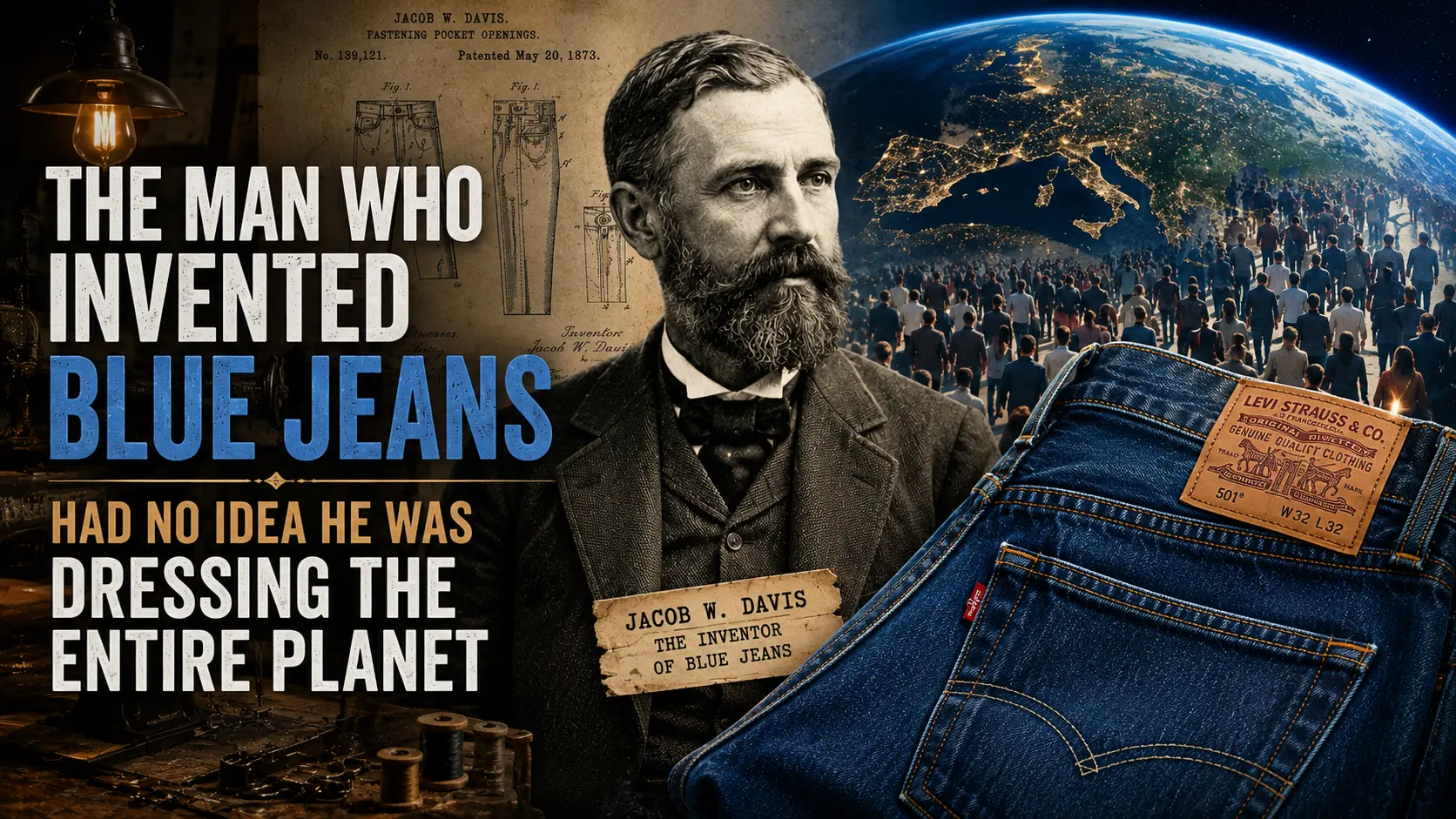
On May 20, 1873, the United States Patent Office granted Patent No. 139,121 for an “Improvement in Fastening Pocket-Openings” to Jacob W. Davis and Levi Strauss and Company. The blue jean was born.
They called them “waist overalls.” The word jeans would not come until much later. They made the first pairs from denim, a tough cotton fabric whose name comes from “serge de Nimes,” after the French city where a similar fabric had been woven for centuries. The indigo dye gave them their colour. The rivets gave them their strength. And the miners, ranchers, railroad workers, and farmers who bought them gave them their meaning.
Davis moved to San Francisco to run Strauss’s factory. He spent the rest of his life there, supervising up to 450 workers, overseeing production of the pants he invented. He died in 1908, relatively obscure, while the name above the door became one of the most recognised on earth.
The Pants That Were Too Tough to Stay Working Class
For the first several decades of their existence, blue jeans were purely functional. They were work clothes. They had no cultural weight, no fashion identity, no meaning beyond durability. Cowboys wore them because they lasted. Miners wore them because they held up to rock and dirt. Farmers wore them because nothing else survived the same abuse.
Then something unexpected happened. In the 1930s, wealthy East Coast tourists started visiting dude ranches out West, and they came home wearing jeans. A 1935 Vogue article advised readers on the proper outfit for a ranch holiday. Vogue. Advising readers to wear work pants. For the first time, denim crossed a line from labour to leisure, from necessity to choice.
World War Two pushed it further. Women entered factories and wore jeans to work. American GIs wore them off duty and carried the look overseas, where European youth saw them as symbols of the freedom and ease of American life. By the time the war ended, jeans were no longer purely a garment of the working class. They were becoming something else entirely.
The Moment Two Actors Made Jeans the Uniform of a Generation
If denim had a cultural detonation point, it was 1953 and 1955, in two darkened cinemas, on two silver screens.
Marlon Brando in The Wild One. James Dean in Rebel Without a Cause.
Brando played a motorcycle gang leader in worn jeans and a leather jacket, sullen and dangerous and entirely magnetic. Dean played a troubled teenager in blue jeans, white t-shirt, and a red jacket, searching for identity in a world that did not make sense. Both characters were exactly what the post-war generation was feeling but had no language for yet. And both of them were wearing jeans.
Schools banned them. Theatres refused entry to anyone wearing denim. Parents hated them. And so, with the perfect logic of teenage psychology, every young person in America wanted a pair.
The ban was the best advertising jeans ever received.
What the film industry did not understand is that you cannot make something uncool by telling teenagers they cannot have it. You simply confirm that it is exactly what they need. By the time the 1960s arrived, jeans had become the uniform of every counter-cultural movement worth joining. Civil rights marchers wore them to show solidarity with the working class. Anti-war protesters wore them on campuses. Woodstock was a sea of denim under an open sky. What started as pants for a Nevada miner had become the clothing of anyone who wanted to signal that they were not playing by the old rules.
How a Work Garment Ended Up on Every Runway in Paris
By the 1970s, jeans were so deeply embedded in everyday life that fashion designers faced a choice: ignore them or absorb them. They absorbed them.
Calvin Klein put his name on the back pocket and sold the idea that what you wore underneath mattered. Gloria Vanderbilt, Jordache, Sergio Valente, suddenly denim was not just functional, it was aspirational. Designer jeans became a status symbol, the same garment that had been banned from schools twenty years earlier was now being advertised in full-page magazine spreads with glamorous models and provocative taglines.
Stone washing arrived and changed everything again. Manufacturers discovered they could make new jeans look old, worn, lived-in, authentic, by tumbling them with stones. They were manufacturing the appearance of experience. Selling nostalgia for a life the buyer had never lived. And people could not get enough of it.
Then came the 1980s and hip-hop, and jeans absorbed another identity entirely. Run-DMC wore them. The Beastie Boys wore them. Denim bent to every subculture that picked it up and came out looking like it had always belonged there.
The Most Democratic Garment Ever Made
Today blue jeans are a $86 billion global industry. They are worn by presidents and protesters, teenagers and grandparents, fashion editors and construction workers. They have been on the moon. They have walked every red carpet. They have been torn, patched, embroidered, bleached, painted, and deconstructed by designers who charge thousands of dollars for the privilege of owning a pair that looks deliberately destroyed.
None of that was in Jacob Davis’s tailor shop in Reno in 1871. He was just trying to stop a working man’s pockets from tearing. He could not afford the patent filing fee on his own. He needed help from his fabric supplier and got lucky that the supplier happened to be a sharp businessman who saw the potential.
Two immigrants, one from Latvia and one from Bavaria, created the most universally worn garment in human history without any idea that is what they were doing. They wanted to sell tough pants to people who needed them. They got a little more than that.
The orange stitching on the back pockets that Davis added in 1873 to distinguish Levi’s jeans from competitors is still there today. Unchanged. On a garment that has outlasted every fashion trend, every cultural shift, every attempt to declare it over, for more than 150 years.
That is not clothing. That is something closer to a miracle.
Frequently Asked Questions
Q1. Who actually invented blue jeans?
Blue jeans were invented by Jacob Davis, a tailor from Riga, Latvia, working in Reno, Nevada. He came up with the idea of placing copper rivets at the stress points of work pants in 1871. Because he could not afford the patent filing fee alone, he partnered with his fabric supplier Levi Strauss, and the two men were granted Patent No. 139,121 on May 20, 1873.
Q2. Why are they called blue jeans and not something else?
The name has two origins. The word denim comes from “serge de Nimes,” a fabric made in the French city of Nimes. The word jean comes from Genoa, Italy, where sailors wore a similar sturdy cotton fabric. Over time the two words merged into everyday language, and by 1960 the term blue jeans had fully replaced the original name Levi Strauss used, which was “waist overalls.”
Q3. Why did schools and theatres ban blue jeans in the 1950s?
After Marlon Brando wore them in The Wild One in 1953 and James Dean in Rebel Without a Cause in 1955, blue jeans became strongly associated with youth rebellion and juvenile delinquency. Schools and theatres banned them specifically because of that association. The ban backfired completely and made jeans more desirable to teenagers than any advertising campaign could have.
Q4. When did blue jeans go from workwear to fashion?
The shift happened in stages. In the 1930s wealthy tourists started wearing jeans on dude ranch holidays and Vogue covered them as leisurewear. The 1950s Hollywood moment gave them cultural weight. By the 1970s designer labels like Calvin Klein had put their names on the back pocket and turned denim into a status symbol. Stone washing in the 1980s made new jeans look worn and authentic, and the transformation from workwear to high fashion was complete.
Q5. How big is the blue jeans industry today?
Blue jeans are today an $86 billion global industry. They are worn across every culture, every income level, and every generation on earth. From fast fashion retailers selling pairs for under $20 to luxury designers charging thousands for a single pair, denim has become the most commercially versatile garment ever created, all traced back to a tailor who could not afford a $68 patent filing fee in 1871.