
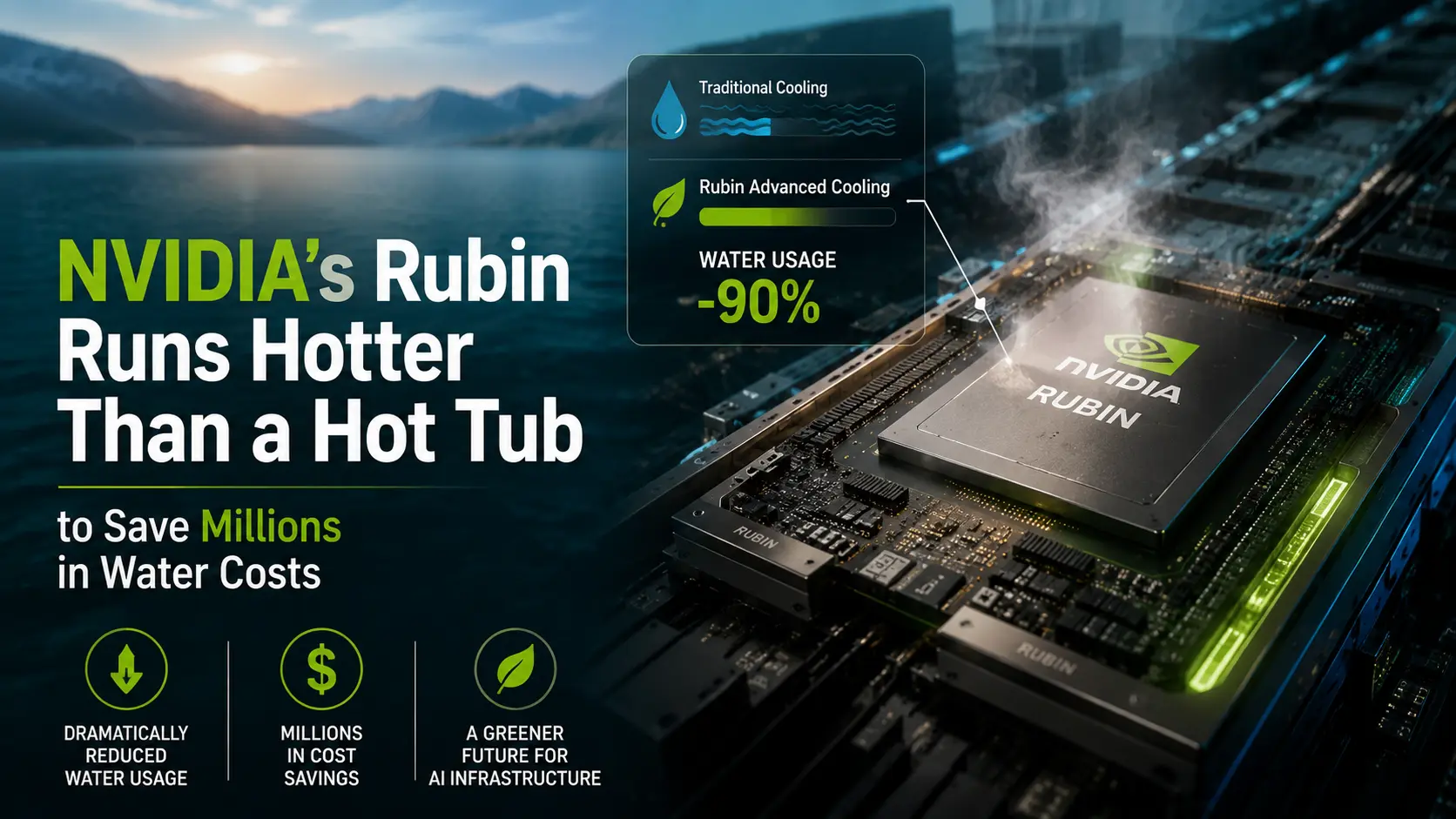
Data centers are thirsty. Not in a metaphorical sense. A single megawatt of AI compute running through a conventional facility drinks roughly 2.6 million gallons of water every year, evaporated into the air through cooling towers doing nothing more sophisticated than making things wet and waiting for them to dry.
Now multiply that by the breakneck pace of AI infrastructure spending in 2026. Google Cloud up 63% in capital expenditure. AWS up 28%. Microsoft committed to $190 billion for the year. Communities near data center hubs in Arizona, Virginia, and across Europe are not quietly accepting this. More than 75 data center build-outs worth $130 billion were blocked in the first three months of 2026 alone.
NVIDIA knows this is a problem. Its answer is Rubin, its next generation of AI infrastructure, and the cooling design at its heart does something that sounds wrong the first time you hear it.
It runs hotter.
Hotter Coolant Is Smarter Coolant
Traditional data centers chill their coolant to somewhere between 7 and 15 degrees Celsius. Keeping liquid that cold in a building full of heat-generating hardware requires large mechanical compressors running around the clock. Those compressors are expensive, loud, and hungry for electricity. Cooling alone has historically consumed up to 40% of a data center’s total power bill.
NVIDIA’s Rubin platform runs its coolant at up to 45 degrees Celsius, or 113 degrees Fahrenheit, warmer than the water in a hot tub. That sounds like a problem. It is actually the solution.
Here is why. The closer your coolant temperature is to the outdoor air temperature, the easier it is to shed heat without mechanical help. At 45 degrees, large outdoor radiator coils called dry coolers can pull the heat straight out of the coolant using ambient air. No compressors. No refrigeration. No evaporation. The coolant loops back inside cooled and ready to go again.
Raising coolant temperature by a single degree cuts cooling energy costs by around 4%. Rubin does not raise it by one degree. It raises it by thirty.
No Fans. No Water. No Hot Aisle.
Walk into a conventional data center and two things hit you immediately. The noise, fans running at 85 decibels or above, loud enough that engineers wear ear protection. And the strange choreography of the floor, hot aisles and cold aisles carefully arranged so cooled air flows across the right components at the right time.
Rubin has none of that. Every chip, every networking component, everything in the rack runs on a single closed liquid loop. The coolant is 75% water and 25% propylene glycol, the same antifreeze compound used in food processing. It flows through cold plates sitting directly on the processors, soaks up the heat at the source, and carries it outside to the dry coolers. It enters the rack at 45 degrees, exits at around 55 degrees with the heat absorbed, and the cycle repeats.
No fans. No evaporation. No water lost to the atmosphere. The coolant loop gets filled once and runs for the life of the facility.
Previous NVIDIA generations were hybrids. GPUs and CPUs got cold plates, but other components still relied on airflow. Rubin drops that compromise entirely. The sealed front panels on Rubin servers, flat and smooth where older servers had perforated bezels, tell the story at a glance.
What Disappears Along With the Fans
The density gains alone would justify the switch. Servers that used to take six rack units now fit in two. That is more compute per square foot, less construction cost, less real estate, less noise.
But the water story is what makes this genuinely interesting. Conventional cooling towers evaporate water to shed heat, the same basic principle as sweating. That water does not come back. At 2.6 million gallons per megawatt per year, a large data center can consume more water than the town it sits next to, which is exactly why those towns are increasingly voting to keep them out.
Rubin’s closed loop changes the equation. Nothing evaporates. Nothing gets replenished. In the right climate, facility-level water consumption drops to near zero. NVIDIA estimates a 50-megawatt facility saves more than $4 million annually just on cooling-related energy and water costs.
The market understood immediately what that meant. When NVIDIA made the announcement at London Climate Week, traditional HVAC stocks dropped. Modine Manufacturing fell 7.5%. Johnson Controls dropped 6.2%. Trane Technologies declined 5.3%. Liquid cooling specialists moved in the opposite direction.
Before You Believe Everything in the Press Release
The engineering here is real. The claims deserve some scrutiny though.
The water savings are climate-dependent. Dry coolers work beautifully in temperate climates where outdoor air stays cool enough to absorb heat from 45-degree coolant. In Phoenix in August, that math breaks down. NVIDIA acknowledges chillers may be needed for around 1% of annual operating hours in the hottest locations. That is not much, but it matters most in the places where water scarcity matters most.
The bigger gap in NVIDIA’s accounting is upstream. The water figures only cover what happens inside the facility. Power plants generating the electricity feeding these racks also consume water, and depending on the energy mix, that upstream footprint can double or triple the total. NVIDIA does not address this, and nobody asking the water question should let that slide.
There is also the cost of getting there. Liquid cooling infrastructure costs more upfront than air cooling. For hyperscalers spending hundreds of billions, that gets absorbed easily. For smaller operators, the savings math looks different. And the world’s existing data center stock was built around air and does not retrofit cheaply.
Why This Still Changes Everything
None of those caveats undo what NVIDIA has actually built. The hardware made liquid cooling mandatory long before anyone drew up a sustainability roadmap. Rubin NVL72 racks pack 72 GPUs and 36 CPUs at power densities above 100 kilowatts per cabinet. At those densities, air cooling does not struggle. It fails. The physics simply stops cooperating.
So the question was never air versus liquid. It was whether the liquid cooling system could be designed well enough to close the loop entirely, eliminating evaporation, eliminating fans, eliminating the water bill. In temperate climates, Rubin does exactly that.
For communities that have been fighting data center construction on water grounds, this does not end the argument. But it changes it. A facility that consumes no cooling water is a different conversation than one drinking millions of gallons a year from an already-stressed aquifer.
The AI buildout is not slowing down. The water table is not refilling. Something had to give, and NVIDIA has found, at least in the right conditions, a way to build at scale without draining what is left.
Also Read: Nvidia RTX Spark: The First PC That Thinks, Acts, and Works on Its Own