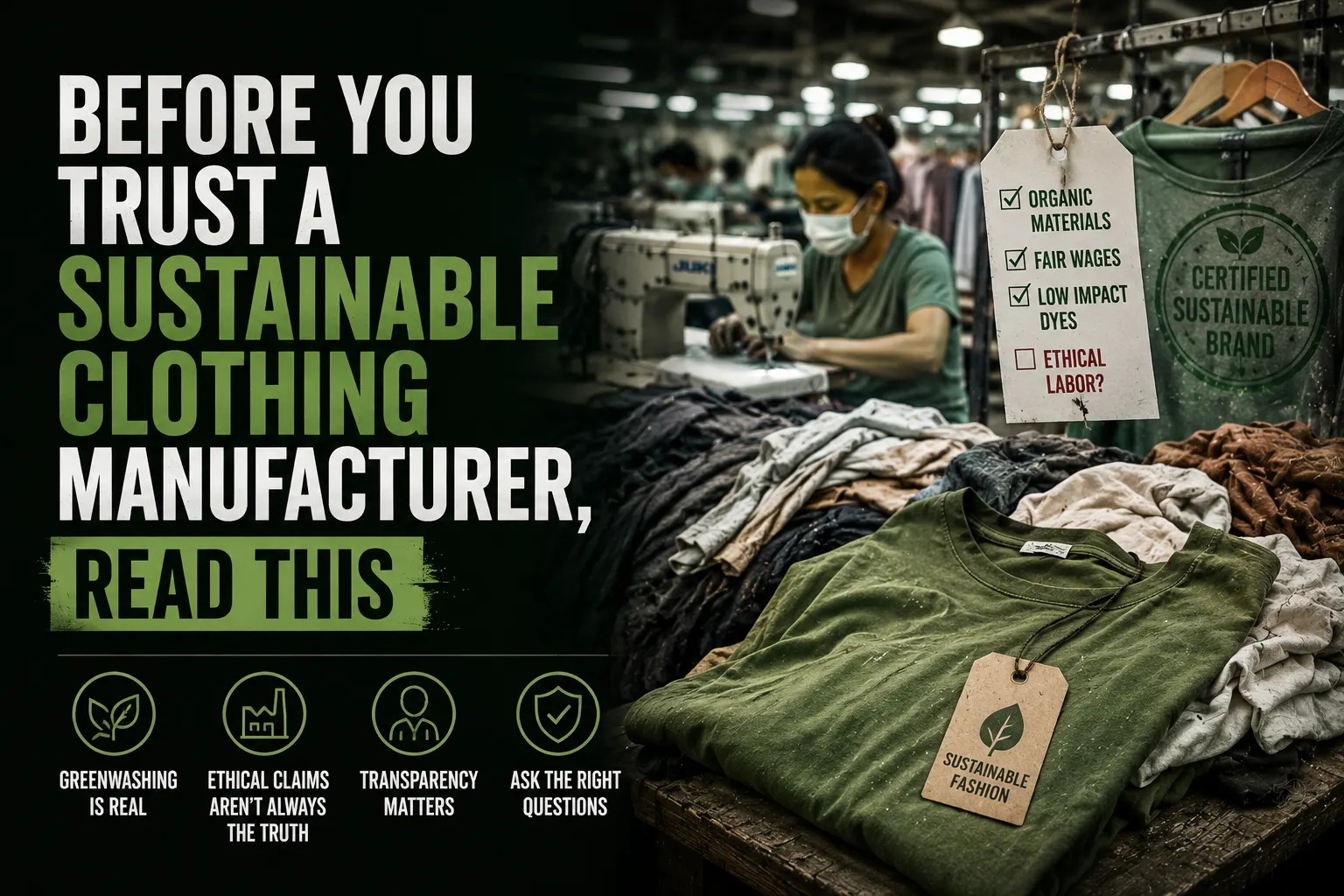
Starting or growing an eco-friendly textile business sounds simple until you reach the hardest question of all: who actually makes your clothes, and can you trust their green claims? The fashion supply chain is crowded with factories that promise sustainability and deliver buzzwords. Getting this wrong does not just dent your margins, it can sink your brand’s credibility overnight.
This ethical sourcing guide breaks down how to evaluate sustainable clothing manufacturers, how to read the two certifications that matter most, and how to spot greenwashing before it becomes your problem.
Table of Contents
ToggleWhy Ethical Sourcing Matters for Your Eco-Friendly Textile Business
The stakes here are high. Fashion is responsible for an estimated 10% of global carbon emissions, along with significant water use, chemical pollution, and waste. Consumers and regulators are paying closer attention than ever, and the penalty for a hollow sustainability claim is steep.
For a brand, your factory is your footprint. You can design the most thoughtful collection in the world, but if it is cut and sewn in a facility with unsafe conditions, unfair wages, or untreated chemical runoff, your “sustainable” label is fiction. Choosing the right partners is not a marketing afterthought. It is the foundation of the entire business.
How to Evaluate Sustainable Clothing Manufacturers
Vetting a factory takes more than a glance at its website. Use this as a working checklist when you assess any potential partner.
Start with proof, not promises. Ask every prospective manufacturer for its certifications by name and number, then verify them directly with the certifying body rather than trusting a logo on a PDF. Request recent third-party audit reports covering both environmental practices and labor conditions.
Investigate labor before you fall in love with the price. A low quote often hides someone else paying the real cost. Ask whether workers earn a living wage rather than just the local minimum, since in many countries those are very different numbers. Ask about working hours, safety, freedom to unionize, and whether the factory is visited regularly, either by your team or a trusted independent auditor.
Trace the chain, not just the final stitch. A responsible manufacturer can tell you where its fabric, dyes, and trims come from. If a supplier cannot explain its own supply chain, that is a signal it either does not know or does not want you to.
Check the environmental basics. Look for wastewater treatment at any wet-processing or dyeing facility, responsible chemical management, and credible handling of waste. Vague reassurance is not the same as a documented system.
Understanding Textile Certifications: GOTS vs OEKO-TEX
Two certifications dominate the conversation, and they are not interchangeable. The simplest way to remember the difference: OEKO-TEX asks whether a textile is safe to wear, while GOTS asks whether it was made responsibly from start to finish.
What Gots Certification Actually Covers
The Global Organic Textile Standard, established in 2006, is widely regarded as the leading standard for organic textiles. Its defining feature is scope. GOTS covers the entire supply chain, from the harvesting of organic raw fibers through manufacturing, chemical inputs, packaging, labeling, and distribution.
Crucially for an ethical brand, GOTS includes social criteria, not just environmental ones. Certified facilities must meet International Labour Organization standards, which cover fair wages, safe working conditions, and a prohibition on child labor. It also requires environmental controls such as wastewater treatment at wet-processing sites and bans on toxic inputs like certain heavy metals and formaldehyde. To carry the label, a product must contain at least 70% certified organic fibers for a “made with organic” claim, and 95% or more for a full “organic” claim. Audits are carried out by independent, accredited third parties.
What OEKO-TEX STANDARD 100 Actually Covers
STANDARD 100 by OEKO-TEX is a globally recognized testing and certification system focused on one thing: chemical safety of the finished product. To earn it, a textile must be tested and proven free from a long list of more than a hundred substances known to be harmful to human health.
Its strengths and limits both come from that focus. OEKO-TEX tests every component, including threads, buttons, zippers, and prints, and it applies to any fiber type, whether organic cotton, conventional cotton, or synthetics like polyester and nylon. What it does not do is certify how or where the product was made, or address labor practices and organic sourcing. It tells you the product is safe, not that it was made responsibly.
GOTS vs OEKO-TEX: Which Does Your Business Need?
The honest answer for most serious sustainable brands is both. They cover different gaps. GOTS verifies organic integrity and ethical production across the supply chain, while OEKO-TEX confirms the final product is free from harmful substances regardless of fiber type. Many manufacturers hold both, and dual certification is one of the strongest credibility signals you can look for. If you work with synthetics or non-organic blends, GOTS will not apply to those materials, which makes OEKO-TEX especially important.
How to Spot Greenwashing: Red Flags Every Buyer Should Know
Greenwashing is when a company uses misleading language to appear more sustainable than it is. The problem is widespread. One study by the Changing Markets Foundation found that the majority of green claims made by fast fashion brands did not hold up, with the false rate reaching as high as 96% in some cases. Here are the warning signs to watch for, whether you are vetting a manufacturer or auditing your own marketing.
Empty vocabulary. Words like “conscious,” “eco,” “responsible,” “earth friendly,” and even “sustainable” have no legal definition on their own. If a claim is not backed by a named certification or a measurable figure, treat it as marketing, not fact.
The green halo. A common trick is showcasing one “hero” product, fabric, or factory while the rest of the business runs on the same unsustainable model. A single recycled-polyester line does not make a high-volume operation ethical.
Numbers without context. Claims like “30% more sustainable” or “reducing emissions” are meaningless without a baseline, a deadline, and third-party verification. Curated statistics with no challenges mentioned usually signal a carefully edited slice of the truth.
No transparency page. A credible operation has a clearly marked section explaining how it defines sustainability, how it audits its supply chain, and how workers are paid and protected. A single vague paragraph buried on the site is a red flag.
Future promises, no plan. Bold pledges set far in the future, with no concrete steps or interim milestones, are easy to make and easy to abandon. Ask what is happening this year, not just by 2030.
Questions to Ask a Factory Before You Sign
Bring these directly to any prospective partner. The quality and specificity of the answers will tell you almost everything.
Which certifications do you hold, and can I verify them with the issuing body? Can I see your most recent environmental and social audit reports? Do workers earn a living wage, and what are your standard working hours? How do you treat and dispose of wastewater and chemicals? Can you trace your fabric and trims back to their source? Can I visit the facility, or arrange an independent inspection?
A genuine sustainable clothing manufacturer will welcome these questions. Evasiveness, generic replies, or pressure to skip the due diligence are themselves the answer.
Building a Credible, Eco-Friendly Textile Business
Sourcing ethically is not a one-time box to tick. It is an ongoing relationship built on verification, documentation, and honesty. Lead with specifics rather than slogans, hold your suppliers to the same standard you advertise to customers, and be transparent about where you are still improving. In a market crowded with greenwashing, that kind of substance is not just the right thing to do. It is your strongest competitive advantage.
Frequently Asked Questions
Q1. What is the difference between GOTS and OEKO-TEX?
GOTS certifies that a textile was made responsibly across the whole supply chain, including organic fiber sourcing and fair labor. OEKO-TEX STANDARD 100 tests the finished product for harmful chemicals and applies to any fiber type. GOTS is about how it was made; OEKO-TEX is about whether it is safe to wear.
Q2. Do sustainable clothing manufacturers need both certifications?
Not strictly, but holding both is a strong credibility signal. GOTS covers organic and ethical production, while OEKO-TEX confirms chemical safety, including for synthetic materials that GOTS does not cover.
Q3. How can I tell if a clothing factory is greenwashing?
Look for vague, undefined terms, claims without certifications or measurable data, a single “green” product used to imply the whole business is sustainable, and a lack of any clear supply chain transparency or audit information.
Q4. What does a living wage mean in ethical sourcing?
A living wage is enough to cover a worker’s basic needs, which is often higher than the legal minimum wage. Paying minimum wage alone does not guarantee ethical labor conditions.
Q5. How do I start an eco-friendly textile business the right way?
Begin with verified suppliers, request certifications and audit reports, trace your materials, and be transparent with customers about your sourcing and your areas for improvement, rather than relying on green buzzwords.