
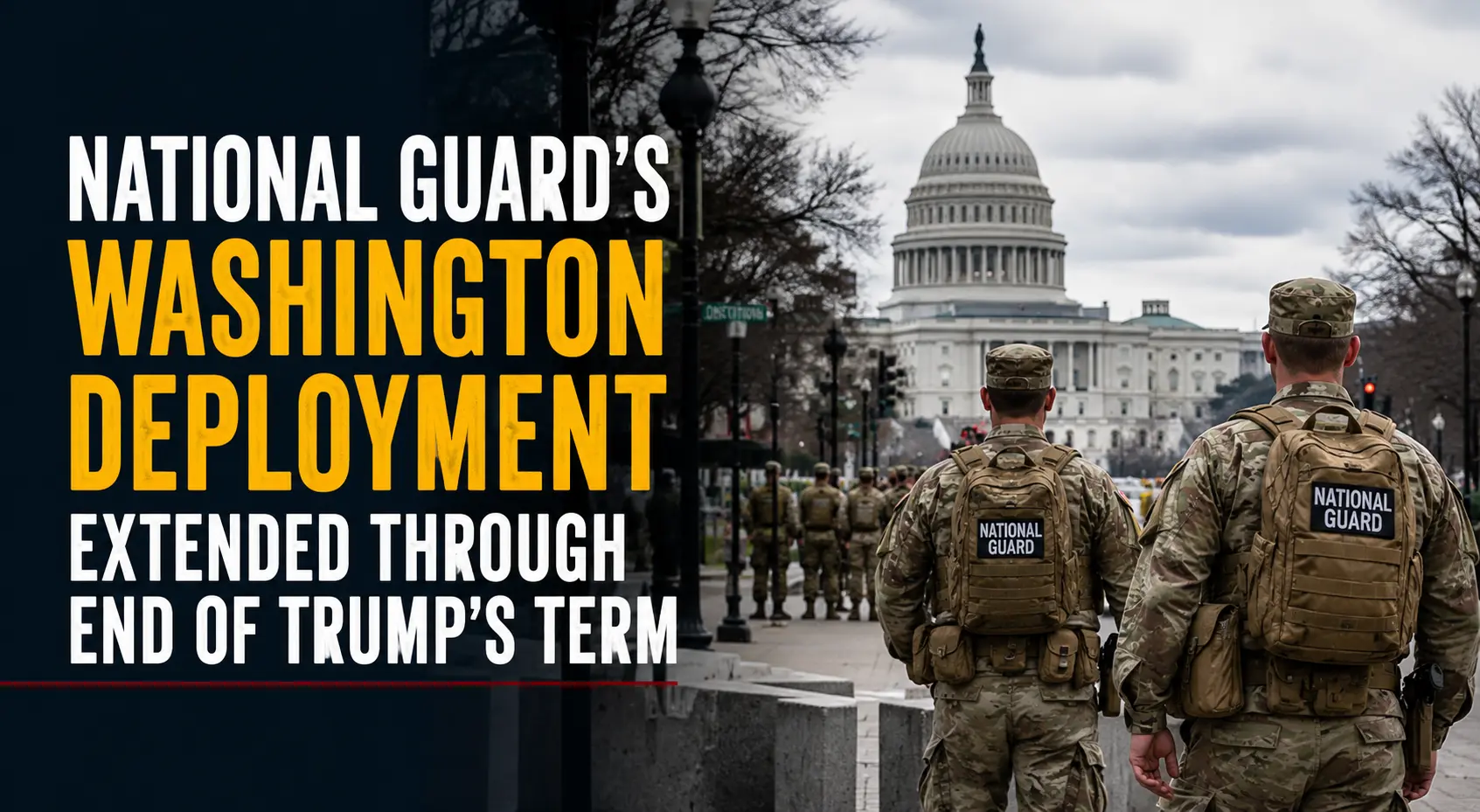
The Pentagon has extended the deployment of National Guard troops in Washington by more than two years, confirming Thursday that the mission will now run through January 20, 2029, the end of President Trump’s current term, unless he ends it sooner.
The deployment had been set to expire at the end of this year after being extended once already. Trump first ordered troops into the capital in August 2025, citing what he called a crime emergency, and the mission has grown into one of the longest sustained domestic deployments of its kind in recent memory.
Because Washington is a federal district rather than a state, the roughly 2,700-member D.C. National Guard reports directly to the president rather than to a governor, giving Trump more direct authority over the mission than he holds over Guard units elsewhere. That structure has also let the administration sidestep several legal challenges that have slowed similar deployments in other cities.
The White House said in April that a joint federal-local task force had made about 12,000 arrests since the mission began, including 62 identified as gang members, and had seized thousands of illegal firearms. A White House official, speaking on condition of anonymity, said Thursday the administration remains committed to the long-term safety of the city for residents and visitors.
Local officials have pushed back on that framing, arguing crime in Washington was already declining before the deployment began. Researchers who have studied the operation describe it less as a targeted crime strategy than as a highly visible, expensive show of force.
A guardsman’s death
The mission has carried real costs for the troops assigned to it. In November, Spc. Sarah Beckstrom was fatally shot while on duty near a Metro station three blocks from the White House, and Staff Sgt. Andrew Wolfe was wounded in the same attack. Authorities said the shooter had driven across the country from Washington state before opening fire. Both guardsmen had been deployed to the capital from West Virginia.
Defense Secretary Pete Hegseth has continued to publicly defend the mission since the shooting, hosting an event at a Washington park earlier this month to thank Guard members for their service to the city. Trump has repeated at multiple public appearances that the city is now safer than it has been in years, though independent researchers and local officials dispute how much credit the deployment deserves for recent crime trends.
With the extension now in place, National Guard troops are expected to remain a fixed presence in the capital for years, raising new questions about long-term funding, staffing rotations and how city leaders will continue to respond to the extended federal presence. Legal experts say Washington’s unique status as a federal district makes this kind of open-ended deployment far easier to sustain here than it would be in most states, a precedent likely to shape how future administrations use the Guard domestically.
The deployment has already been extended once before, having initially been expected to wind down earlier this year before the Pentagon pushed the timeline to December. Thursday’s announcement supersedes that shorter extension entirely. Guard members serving in the city do not have arrest powers themselves, but officials say their visible presence alongside federal law enforcement has been central to the administration’s public safety messaging around the mission.
Some Washington residents say the constant presence of uniformed troops near landmarks like the Lincoln Memorial and Washington Monument has changed the everyday feel of the city, for better or worse depending on who is asked. City leaders have said they plan to continue raising objections to the extended federal footprint, though they acknowledge having limited legal leverage given Washington’s status as a federal district rather than a state.