
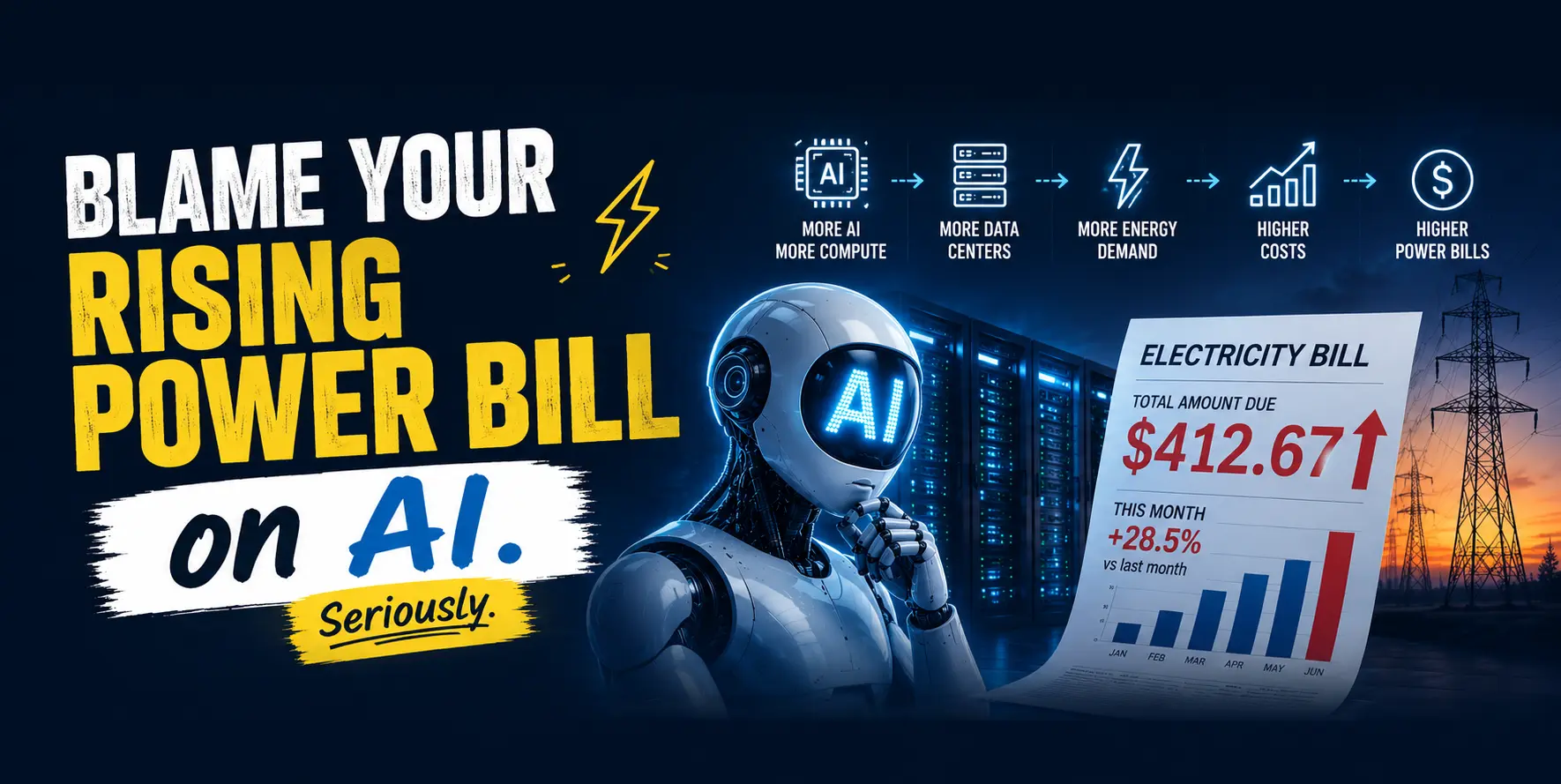
John Steinbach opened his electric bill in January and did a double take. $281. The month before: about $100. He’d lived in his Manassas, Virginia home for nearly 40 years and never seen a jump like it.
He’s not alone, and he’s not imagining a conspiracy. He’s living next to the AI boom.
Why it matters: Electricity prices rose 6.9% last year, more than double the rate of inflation, and Goldman Sachs says data centers are responsible for about 40% of that growth in demand. Your bill isn’t going up because of some vague “economy stuff.” It’s going up because a data center near you needs more power than a small city.
The numbers behind the squeeze
Here’s what’s driving it, in plain terms:
- A single AI task can burn up to 1,000 times more electricity than a normal web search.
- More than 3,000 data centers already operate in the U.S., with another 1,489 planned or under construction.
- PJM Interconnection, which runs the grid across 13 states including Ohio, Pennsylvania and Maryland, just cleared its power auction at a record price for the second year running. Total bill: $16.1 billion. Two years ago it was $2.2 billion.
- Goldman expects household electricity prices to climb another 6% through 2027 before things cool off.
PJM’s Stu Bresler put it simply: data centers are driving the “majority” of a projected 5,400-megawatt jump in demand next year. That’s not a rounding error. That’s a new industrial customer showing up in your neighborhood and eating the power that used to be spread across everyone.
Politicians have noticed
This has stopped being a wonky energy-policy story and become a campaign issue. Democrats Mikie Sherrill and Abigail Spanberger both won governor’s races last year in New Jersey and Virginia partly by promising to get utility bills under control. Congress is now debating whether tech companies, not ratepayers, should cover the cost of the grid upgrades their data centers require.
Reps. Mike Levin and Kathy Castor introduced the SHIELD Act in January to do exactly that. Castor’s pitch: massive companies should pay for the infrastructure they need instead of quietly passing the bill to families and small businesses.
It wasn’t always like this
Data centers weren’t always the villain in this story. A study from the Electric Power Research Institute found that data centers built between 2019 and 2024 actually helped lower residential rates, by spreading fixed grid costs across more customers. EPRI’s Asa Watten estimated rates would have been roughly 6% higher in that window without them.
The math flipped once AI showed up. Old data centers sipped power. AI data centers guzzle it, and the grid, built decades ago for a very different world, wasn’t designed for the load.
What’s next
Utilities are asking regulators for permission to raise rates at a record clip, $31 billion in requested increases last year, more than double 2024. Some states are pushing back, exploring rules that would force data center operators into long-term contracts covering their share of new infrastructure, so the bill doesn’t quietly land on your kitchen table instead.
Tech companies argue the buildout will eventually benefit everyone, new transmission lines, new power plants, a modernized grid. Maybe. But “eventually” doesn’t help homeowners staring at a bill that just doubled.
The bottom line: The AI boom needs somewhere to plug in, and right now, that somewhere is the same grid that powers your house. Until regulators change who pays for the upgrade, expect more bills like Steinbach’s.
It’s not just your power bill
Goldman’s analysts also warned the ripple effects reach further than electricity. Higher power costs for hospitals, restaurants, and factories tend to show up later as higher prices for food, clothing, and transportation, since businesses pass their own rising energy costs down the chain. The bank expects that trickle-down inflation to keep nudging up everyday prices through 2027, hitting the same households already absorbing the direct hit on their utility bills.
Some states are trying a more surgical fix than blanket rate hikes. Ohio’s Public Utilities Commission approved a new rate structure last year requiring large data center customers to commit to minimum payments over multi-year contracts, specifically to stop a company from walking away and leaving other ratepayers to cover stranded infrastructure costs. Whether other states follow that model, or let the costs keep flowing downhill to households like Steinbach’s, is likely to be one of the bigger utility policy fights of the next two years.