
For ten years the government has planned the party for America’s 250th birthday. It took less than two weeks of setup to put fuel into the ground beneath the National Mall, and nobody can yet agree on how much.
More than 30 gallons of fuel leaked onto the National Mall from generators tied to events marking the nation’s semiquincentennial, according to three people familiar with the matter who spoke to NBC News. The events were organized by Freedom 250, a public-private partnership the Trump administration created to fund and stage the 250th-anniversary celebrations. The fuel did not simply pool on the grass. It traveled down into the underground cisterns that store rainwater used to irrigate the Mall, turning a surface accident into a contamination problem that is now driving an active remediation operation in the middle of one of the most visited public spaces in the country.
What the National Mall Diesel Spill Actually Released, and Where It Went
The detail that separates this from an ordinary construction-site mishap is the destination of the fuel. Four cisterns sit beneath the National Mall, collectively able to hold up to 250,000 gallons of rainwater that the National Park Service uses to keep the turf alive. According to people familiar with the matter, diesel from commercial generators seeped directly into that system. Contaminating an irrigation cistern is a different category of problem from a spill that stays on the surface: the fuel mixes with stored water meant to be pumped back onto the grass, and the contamination can spread through the connected plumbing rather than staying in one patch of soil.
The New York Times, citing a government document and an Interior Department spokeswoman, reported that the fuel was diesel and that it came from supply lines feeding diesel-powered lighting systems, equipment installed for the Great American State Fair, a 16-day event scheduled to run on the Mall through the summer. NBC News attributed the generators to the May 17 “Rededicate 250” gathering. Both threads point to the same underlying cause: temporary power and lighting hardware brought in for the 250th celebrations, with fuel lines that failed.
Timeline of the National Mall Diesel Spill Before America’s 250th Anniversary
This was not a single event. Government records cited by The New York Times describe diesel spilling onto the Mall at least twice within about two weeks during the run-up to the celebrations. The first spill, on May 20, contaminated one of the irrigation cisterns. A second leak followed days later, on a Wednesday night, and its environmental impact has not been publicly assessed. Neither the government nor the organizers have said how much fuel escaped in that second incident.
The “Rededicate 250” event that the generators served took place on May 17 and drew thousands to the Mall for a day of prayer, music and speeches. Among the speakers were Secretary of State Marco Rubio, Defense Secretary Pete Hegseth and House Speaker Mike Johnson. Within days of that crowd dispersing, fuel was in the ground.
National Mall Fuel Cleanup Efforts Are Now Visible From the Grass
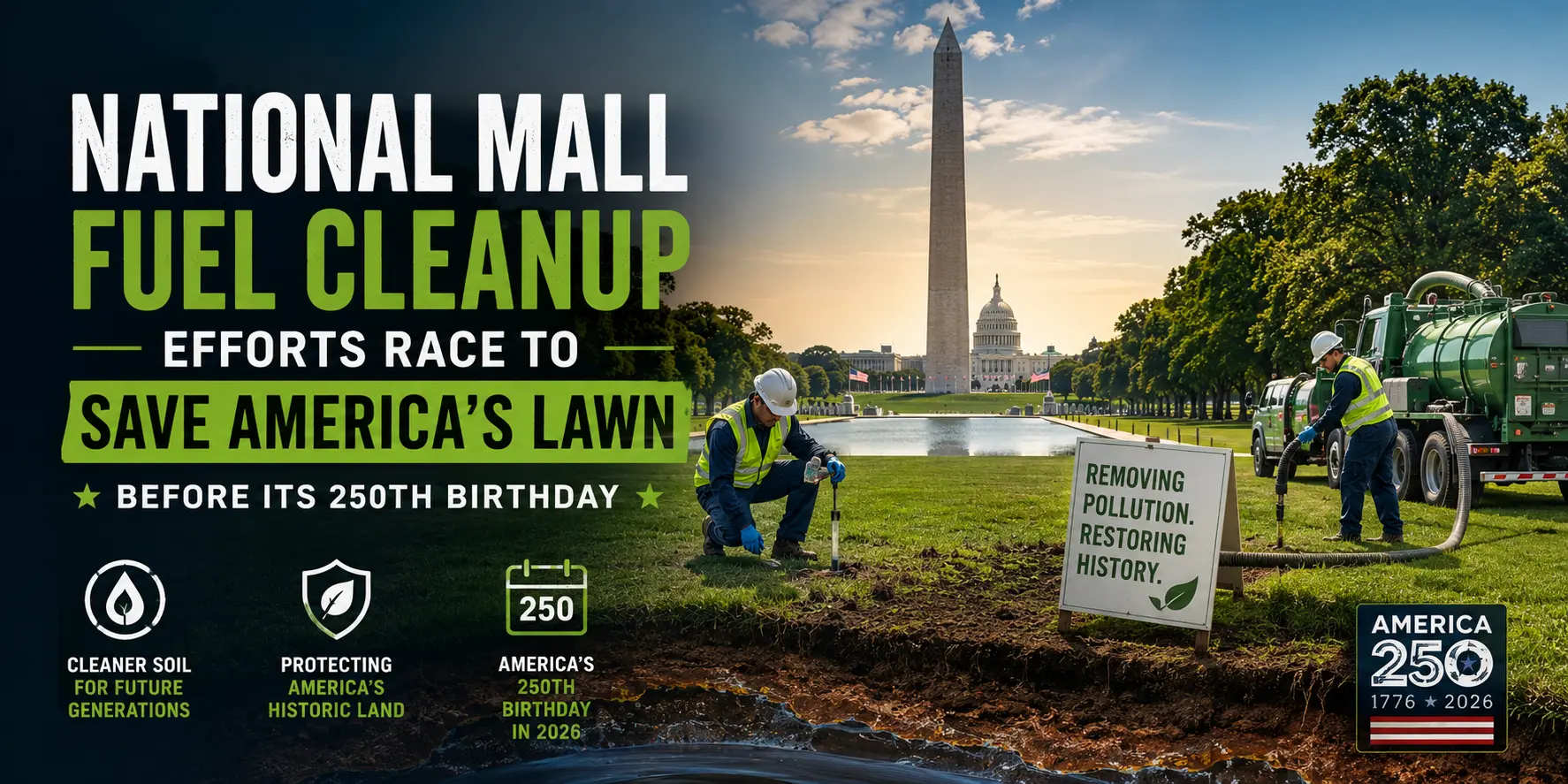
The remediation is not theoretical or scheduled for later. It is physically occupying the Mall right now. On Monday morning, NBC News observed a “Mobile Command Center” belonging to Lewis Environmental, a remediation contractor, parked at the exact site where the Freedom 250 event had been staged. Alongside it sat more than a dozen “Rain for Rent” trailers, the industrial water-and-liquid-handling units typically deployed to pump, store and treat contaminated water.
That equipment footprint is the clearest public signal of how the national mall fuel cleanup efforts are being run: contain the affected cistern water, move it off-site for treatment, and flush the system before contaminated water can be cycled back onto the turf. Freedom 250 says this response began almost immediately. Its spokeswoman, Rachel Reisner, said crews mobilized within minutes of finding the damaged fuel line and that the site was fully remediated in partnership with the National Park Service. Neither the Park Service nor Lewis Environmental has responded to requests for comment on the scope of the work or its cost, leaving the organizers’ “fully remediated” characterization unverified by the agency overseeing the land.
30 Gallons or 2.5? The Disputed Size of the National Mall Diesel Spill
How much fuel actually went into the ground is openly disputed, and the spread is enormous. For the first spill, the federal government’s figure was 30 gallons. The nonprofit organizing the events put it at between 2 and 2.5 gallons, a difference of more than tenfold. An Interior Department official went further, telling The Independent that the amount spilled was much lower than NBC News had reported.
The discrepancy is not a footnote. The volume of fuel determines the scale of the contamination, the cost of the national mall fuel cleanup efforts, and the degree of liability the organizers face. A 2-gallon spill and a 30-gallon spill that reached a 250,000-gallon cistern system imply very different remediation jobs and very different bills. With the second leak’s volume still unstated by anyone, the public does not yet have a confirmed total for how much diesel entered the Mall.
The Vandalism Claim Driving the Freedom 250 Spill Investigation
Both Freedom 250 and the Interior Department have offered the same cause: vandalism. Reisner said the group’s temporary lighting equipment had been repeatedly targeted and that the recent fuel leak was the direct result of that tampering. The Interior Department’s spokesperson framed it as a deliberate act by someone who cut a fuel line, calling it “unhinged behavior that will not be tolerated” and vowing the celebrations would proceed.
What’s missing is corroboration. No suspects have been publicly identified. Authorities have not released investigative findings explaining how the equipment was supposedly tampered with, and federal officials have not detailed publicly how much fuel reached the cistern system or whether contamination spread beyond the immediate area. NBC News also reported that some people familiar with the matter did not frame the cause the way the organizers did, meaning the vandalism account, while the official one, is not the only account. Washington’s Metropolitan Police Department referred questions to the National Park Service.
Who Pays for the National Mall Fuel Cleanup Efforts and the Freedom 250 Liability
The liability question is unsettled and financially significant. Under normal practice, one person familiar with the matter said, the National Park Service would hold the permit holder responsible for environmental mitigation after a spill of this magnitude. Park Service guidelines indicate that commercial liability insurance is required as part of the permit for an event of this size and scope.
But it is unclear whether Freedom 250 and Event Strategies Inc., the firm that helped organize the events, will ultimately be on the hook for the cleanup costs, particularly given that the organizers are attributing the leak to outside vandalism rather than their own equipment failure. That framing, if accepted, could shift the question of who bears the cost. With the Park Service not commenting, there is no public confirmation yet of who is paying for the remediation now underway.
National Mall Fuel Cleanup Efforts Race the Great American State Fair Calendar
The timing is the part that turns an environmental incident into a logistical crisis. The Mall’s grass was already considered vulnerable before any fuel touched it, because of the sheer density of high-foot-traffic events booked there this summer. The contamination adds fresh doubt about whether the existing turf survives the season.
The calendar is unforgiving: the Great American State Fair is set to run 16 days on the Mall, a Fourth of July “Salute to America” celebration is planned, and an IndyCar race is scheduled for August. Each event means more crowds, more equipment, and more strain on grass that now also needs to recover from diesel exposure and the disruption of an active remediation site. The national mall fuel cleanup efforts are therefore not just about scrubbing one cistern. They are about whether the centerpiece lawn of the country’s 250th birthday is presentable when the celebrations actually arrive.
The Bottom Line
A celebration of America’s founding, organized by a partnership the administration itself created, has left fuel in the soil and water beneath the nation’s most symbolic public lawn. The organizers say they fixed it within minutes. The government’s own spill figure is more than ten times the organizers’ estimate. A second leak’s volume remains unknown, no vandalism suspect has surfaced, and the agency responsible for the land has gone silent. Until the National Park Service confirms the scope, the cost and the cause, the national mall fuel cleanup efforts will remain exactly what they look like from the grass right now: an open question parked in the middle of the Mall.