
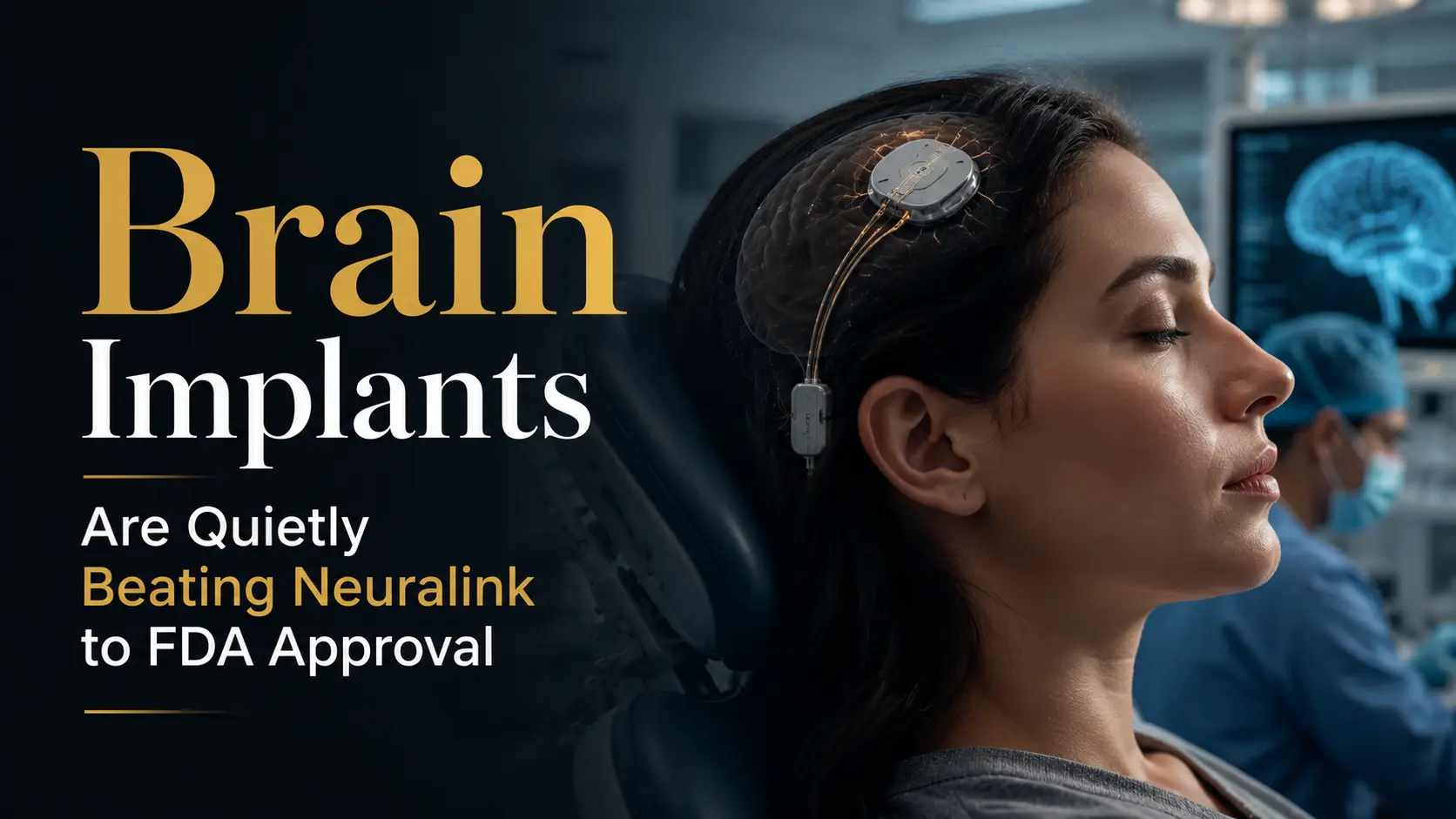
In January 2024, a paralyzed man named Noland Arbaugh got a Neuralink chip implanted in his brain. Within weeks, he was playing online chess using only his thoughts. It was the moment brain-computer interfaces stopped being science fiction for most people and started being news.
Two years later, Neuralink isn’t the company furthest along with regulators. That title may belong to someone else entirely.
Why it matters: Precision Neuroscience, founded by a Neuralink co-founder who left to build something different, got FDA clearance in April 2025, more than a year before Neuralink or Synchron reached a comparable milestone. The brain-computer interface race has quietly become a three-way fight, and the company with the least name recognition is currently winning on paperwork.
Three companies, three completely different bets
Neuralink: High-density electrodes implanted directly into brain tissue. Best signal quality, requires real brain surgery. Its PRIME study has implanted roughly 21 patients across four countries, racking up thousands of hours of at-home cursor and keyboard use.
Synchron: No brain surgery at all. Its Stentrode device threads through a blood vessel, like a cardiac stent, up into the brain. Lower signal resolution, dramatically lower surgical risk. Six patients in its COMMAND study, zero serious device-related complications. A pivotal trial is planned for this year, the last major hurdle before Synchron can seek the first-ever full approval for a permanently implanted communication BCI.
Precision Neuroscience: A thin film, thinner than a human hair, that sits on the brain’s surface rather than piercing it. FDA-cleared in April 2025 for use up to 30 days, currently being sold for brain mapping during surgery. CEO Michael Mager says the company built its own manufacturing facility and went from founding to FDA clearance in just four years.
None of these devices are available to the general public. All three companies are still operating under FDA research exemptions, not full market approval.
Why three approaches beat one
Every current trial targets the same population: people with severe paralysis who have no other way to communicate or control a computer. But no single electrode design fits every patient or condition, which is exactly why having Neuralink, Synchron, and Precision Neuroscience racing in parallel is good news rather than redundant effort.
The field goes deeper than the headline three. Paradromics is building a high-bandwidth interface for especially dense signal capture. Onward, based in the Netherlands, is focused specifically on restoring movement after spinal cord injuries. Blackrock Neurotech and Kernel are each chasing narrower medical applications.
The money and the questions
Neuralink’s valuation has topped $8 billion. Grand View Research projects the global BCI market hits $8 billion to $12 billion by 2030. Synchron closed a $200 million funding round last November and has partnered with Apple to let its implant control an iPhone or Vision Pro directly, a hint at where this technology eventually points beyond medicine.
The FDA is still building the rulebook as these companies go, since implanted brain devices didn’t fit neatly into any existing device category. New cybersecurity guidance now requires threat modeling for wireless brain implants specifically, an early sign of a bigger question nobody has fully answered yet: who owns the data generated by your own brain.
The bottom line: Analysts don’t expect a first full FDA approval before 2027, with real commercial availability more likely in the 2028-to-2030 range. For patients enrolled in these trials today, that timeline is secondary to a simpler question: does it actually give back what they lost.
Where the money is actually pointing
Arbaugh’s chess game wasn’t a one-off stunt. By early this year he’d logged thousands of hours of continuous use, and Neuralink has since expanded its own trial to more than a dozen participants. That kind of sustained, real-world data is exactly what regulators want to see before approving a device for anything beyond a research protocol.
The commercial appetite extends beyond medicine, too. Synchron’s Apple partnership hints at a future where BCI signals control consumer devices directly, and industry analysts increasingly talk about enterprise applications in aviation and defense alongside the medical use cases driving today’s trials. None of that changes the near-term reality: every current trial exists to help people who have lost the ability to move or communicate get some of it back, and that population remains the only one any of these devices can legally serve today.