
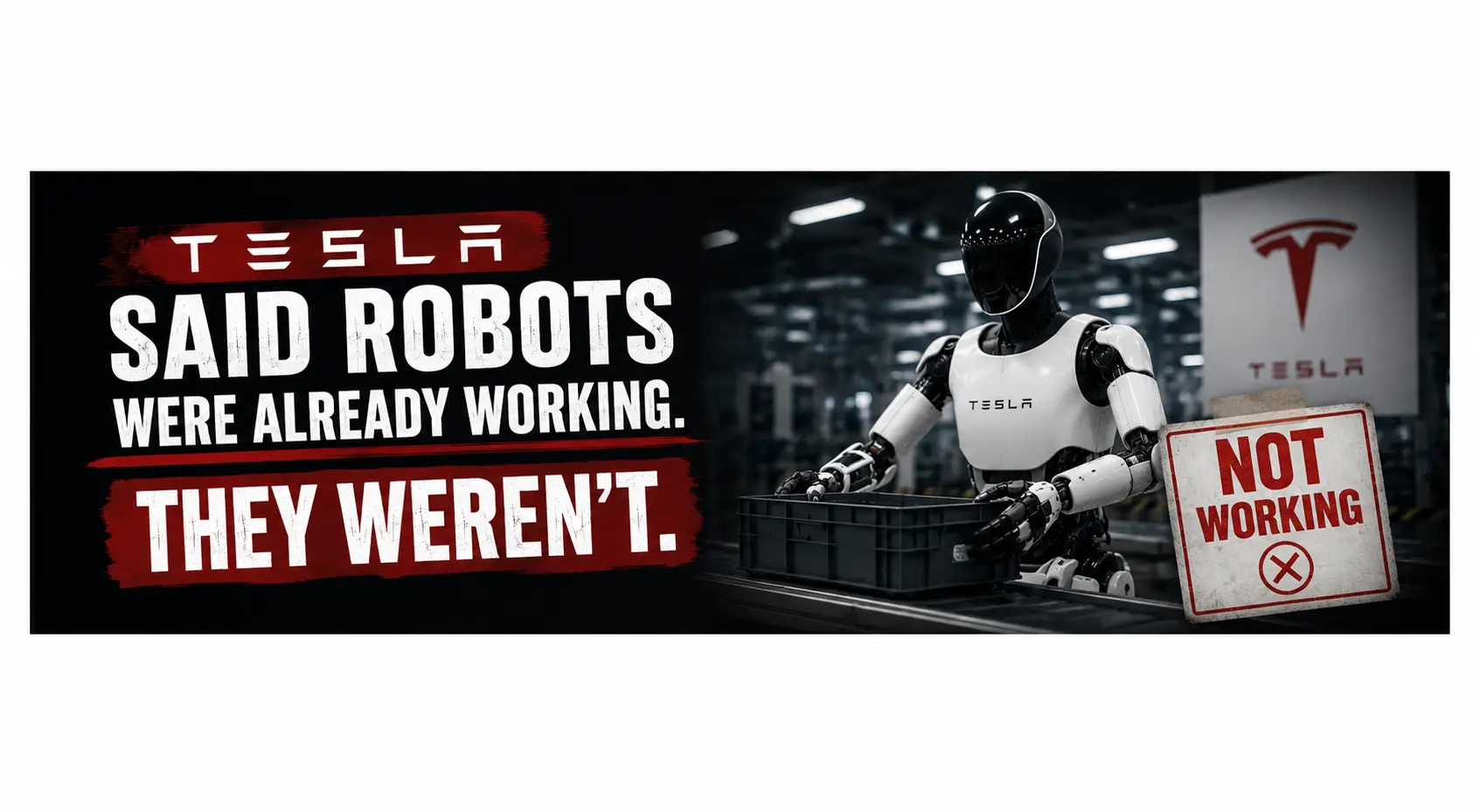
In January 2025, Elon Musk told Tesla investors the company’s internal plan called for building roughly 10,000 Optimus robots that year. One year later, on the exact same earnings call format, a reporter asked him a simple question: how many robots are actually doing real work in your factories?
Musk didn’t give a number. What he gave instead was an admission.
Why it matters: For two years, Tesla has sold the public on a vision of humanoid robots already working Fremont’s floors, handling batteries, learning on the job, closing in on mass production. Musk just confirmed, in his own words, that none of it is true yet.
What he actually said
According to a transcript published by The Motley Fool, Musk described Optimus as still in an early, R&D phase of development. The robots have handled a few basic tasks on the factory floor, he said, but conceded the program is “not in usage in our factories in a material way.” Mostly, he explained, the robots are there so the system can learn.
Read that again next to his own past statements:
- June 2024: Tesla’s official account claimed two Optimus units were “performing tasks in the factory autonomously.”
- June 2024: Musk told shareholders he expected one to two thousand robots working in Tesla factories by 2025.
- January 2025: Musk raised that number to roughly 10,000 units planned for the year.
- Reality, per independent estimates from Forbes and supply-chain outlet DigiTimes: a few hundred units, at most, through all of 2025.
That’s not a rounding error. That’s a gap between marketing and manufacturing that’s lasted two full years.
Everyone else is further along, and further behind
Tesla isn’t the only company chasing this market, and it isn’t the leader either, at least not by what’s actually shipped. Figure AI has real units doing sub-assembly work at a BMW plant in South Carolina. Agility Robotics has run a year-long pilot with its Digit robot at Toyota. Apptronik has shipped units to a Texas fulfillment center. Boston Dynamics is leasing its electric Atlas platform commercially to Hyundai.
None of this is at industrial scale either. Trackers that comb through earnings calls and public filings put total humanoid robot deployments across the entire industry in the hundreds of units, not thousands, and nowhere near the millions Musk has floated in past predictions.
Why the gap keeps happening
Cost is one wall. Atlas-class robots have historically run $50,000 to $250,000 per unit. Musk wants Optimus down to $20,000 to $30,000 at scale, a price that would actually make sense for a mid-size factory. Getting there requires manufacturing volume Tesla hasn’t come close to yet.
Reliability is the other wall. Reporting from Electrek and other outlets, citing supplier accounts, has pointed to overheating joint motors, weak hand grip strength, and short battery life on early Optimus units, plus a mid-2025 production pause to redesign the hands entirely. Rodney Brooks, the roboticist who co-founded iRobot, has called the broader vision of a general-purpose home robot assistant premature, bluntly.
Musk has a track record of timelines that don’t hold. In 2011 he told the Wall Street Journal SpaceX would put an astronaut in orbit within three years. That happened in 2020, nine years later.
The bottom line: Tesla is now converting its old Model S and Model X assembly line in Fremont into dedicated Optimus production space, Musk’s biggest bet yet that the robots will eventually catch up to the hype. Until they do, his own admission that the robots aren’t doing real work yet remains the most honest thing Tesla has said about Optimus in two years.
The competitor that’s actually shipping
While Tesla explains why its robots aren’t ready, a Chinese competitor is quietly ahead on the one metric that actually matters: shipping. Kepler’s K2 Bumblebee is a commercial product today, with a published price, framework agreements covering thousands of units, and a demonstrated eight-hour continuous operation record that Tesla hasn’t matched publicly.
Tesla’s own credibility problem isn’t new, either. A widely viewed 2024 “We, Robot” event showed Optimus units serving as bartenders, a demo that only later turned out to rely partly on remote human operators rather than full autonomy, a detail that surfaced after the footage had already gone viral. Investors keep asking Musk for a straight answer on how many robots are actually working. He has yet to give one.