
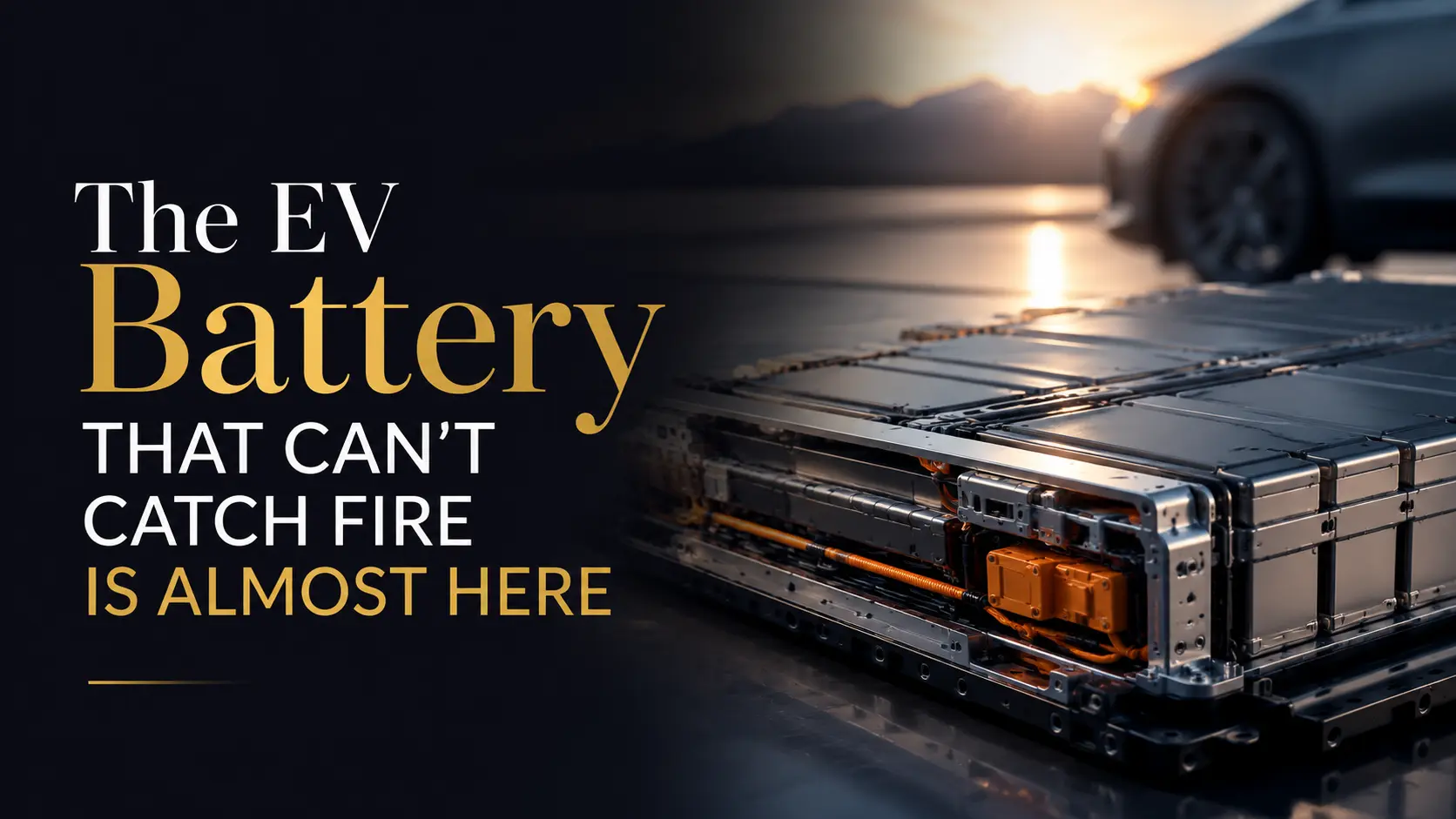
Every lithium-ion battery on the road today has the same weak point: a liquid electrolyte sloshing between the electrodes. It’s flammable. It’s heavy. And under enough heat or physical damage, it can ignite.
Toyota and Sumitomo Metal Mining think they’ve found the fix, and last October they announced a joint venture to mass-produce it.
Why it matters: Solid-state batteries swap that flammable liquid for a solid material, cutting fire risk to nearly zero while packing in far more energy per pound. Automakers have chased this technology for more than 20 years. It’s now close enough that real production timelines exist, not just concept-car promises.
Who’s actually building it
Toyota has sunk more than $15 billion into solid-state R&D and holds more patents in the space than anyone else. Its target: production vehicles by 2027 or 2028, starting with hybrids, with cells that charge from 10% to 80% in under 10 minutes and push range past 600 miles. The company says it’s aiming for packs durable enough to hold 90% of their capacity after decades of use.
Samsung SDI isn’t far behind. It’s been running a pilot solid-state line in South Korea since 2023, partnered with BMW and Colorado-based Solid Power, and is targeting 2027 for limited production. Its prototype cells reportedly hit roughly 900 watt-hours per liter, close to double what today’s best lithium-ion packs manage.
Then there’s the wild card: Greater Bay Technology, a Chinese startup backed by automaker GAC, claims it will hit gigawatt-hour-scale solid-state production by the end of this year. If true, that would put a relatively unknown startup ahead of Toyota, Samsung, Panasonic and QuantumScape, companies that have collectively burned through billions without reaching mass production. Analysts are skeptical. History suggests they should be.
The nearer-term reality: hybrid cells
While true solid-state batteries stay a few years out, a related technology is already on the road. Semi-solid, or “hybrid,” cells keep a small amount of liquid electrolyte, usually 5% to 15%, alongside a solid component. They’re easier to manufacture today, at the cost of some safety benefit.
Chinese automakers Nio and IM Motors have already shipped hybrid cells in production vehicles, hitting energy densities of 300 to 360 watt-hours per kilogram. That’s a real step up from standard lithium-ion, and it’s giving battery makers something true solid-state can’t yet offer: actual manufacturing experience at real volume.
Why this is so hard to build
The jump from a working lab cell to a factory producing millions of identical, reliable batteries is the hardest part of any new battery chemistry, and solid-state cells have a particularly brutal version of the problem. The solid electrolyte has to maintain perfect contact with the electrodes through years of vibration, temperature swings, and charge cycles. One microscopic manufacturing defect, and the battery loses capacity far faster than lab tests predicted.
QuantumScape is the cautionary tale here. More than a decade of work, billions of dollars raised, and its best public result is still a lab benchmark: 80% capacity retention after 400 cycles under controlled conditions. That’s meaningfully short of the millions of cycles a real car battery needs to survive.
What this means for your next car
If you’re buying an EV in the next few years, you’re almost certainly still buying lithium-ion, and that’s not necessarily bad news. Cheaper iron-based cells and silicon-anode designs keep pushing range up and prices down in the meantime.
Solid-state’s first real customers will be buyers of $80,000-plus vehicles, following the same path lithium-ion took decades ago from laptops to cars. Most analysts put true mass-market solid-state EVs, the kind under $40,000, around 2030 or later.
The bottom line: The battery that can’t catch fire is real, it’s funded, and it’s finally moving toward factories instead of lab benches. It’s just not moving fast enough to be in your driveway next year.
China is setting the pace on paper
China’s official government roadmap targets 500 watt-hour-per-kilogram true solid-state cells by 2035, and the country is expected to release its first national solid-state battery standard this month, a regulatory move that would give Chinese manufacturers a formal benchmark years before most Western regulators have one. Dongfeng, one of China’s state-backed automakers, has said it’s planning mass production of 350 watt-hour cells by the end of this year.
Nissan, Honda, Hyundai-Kia, and Volkswagen’s PowerCo division are all running their own solid-state or semi-solid pilot programs in parallel, most aiming for the early 2030s. No single company owns this race yet, and given how many well-funded players have already missed their own targets, healthy skepticism about any single announced date remains the safest bet for anyone actually shopping for a car.