
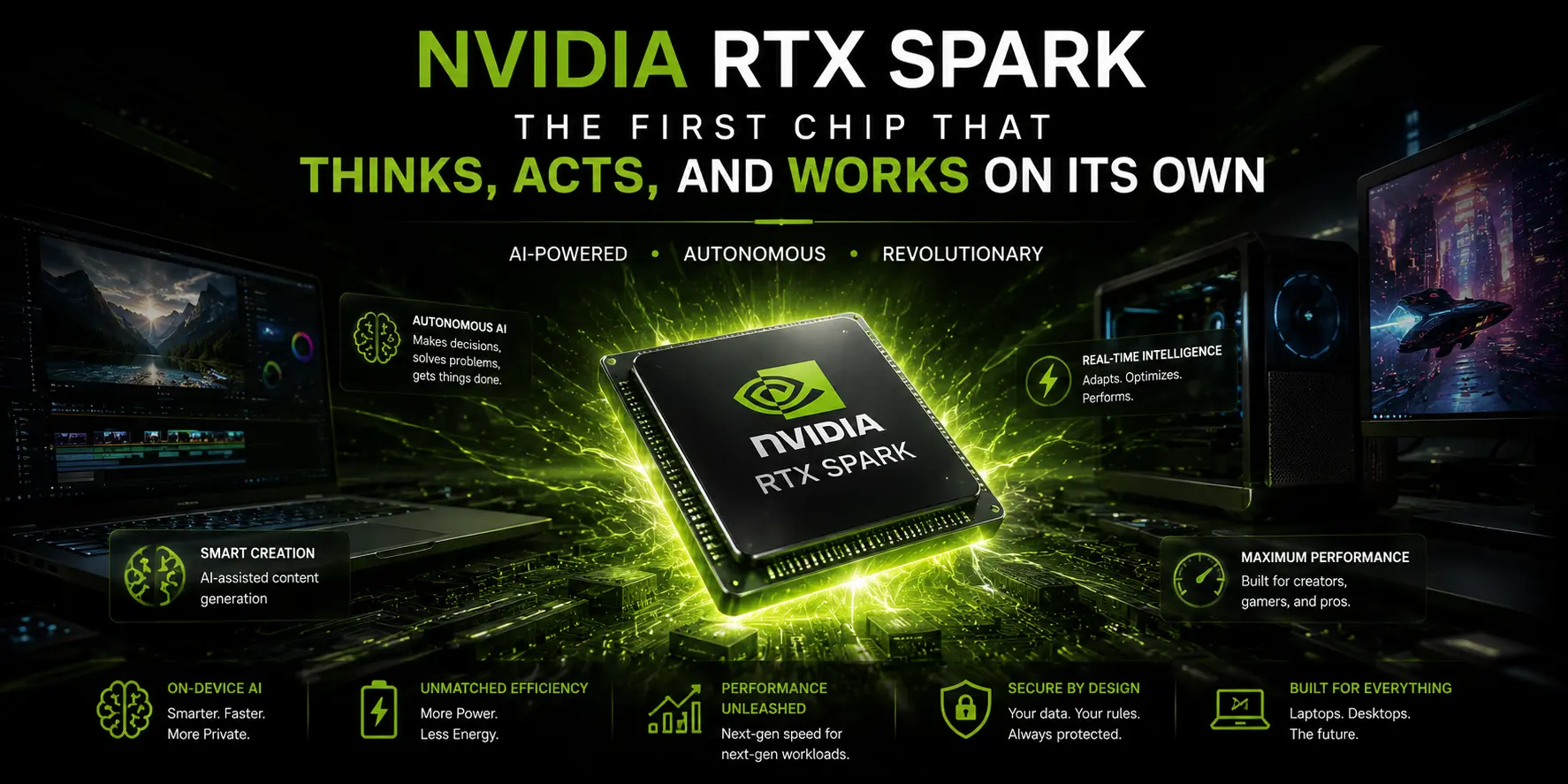
For forty years the personal computer has worked the same way. You open an app, you click, you type, and the machine waits for your next instruction. On May 31, 2026, at Nvidia’s GTC Taipei keynote during Computex, that contract was quietly torn up. Nvidia and Microsoft announced RTX Spark, what they are calling the world’s first Windows PCs purpose-built for personal AI agents. For the first time in a generation, the question is no longer what you can do with your computer. It is what your computer will do for you.
This is not another spec bump. It is a bet that the most ordinary object in modern life, the device hundreds of millions of people sit in front of every day, is about to change at its core. This guide explains exactly what was announced, what the buzzwords actually mean in plain words, what one of these machines could do for you, how it compares to what you already own, what it costs, and whether you should care.
What is Nvidia RTX Spark?
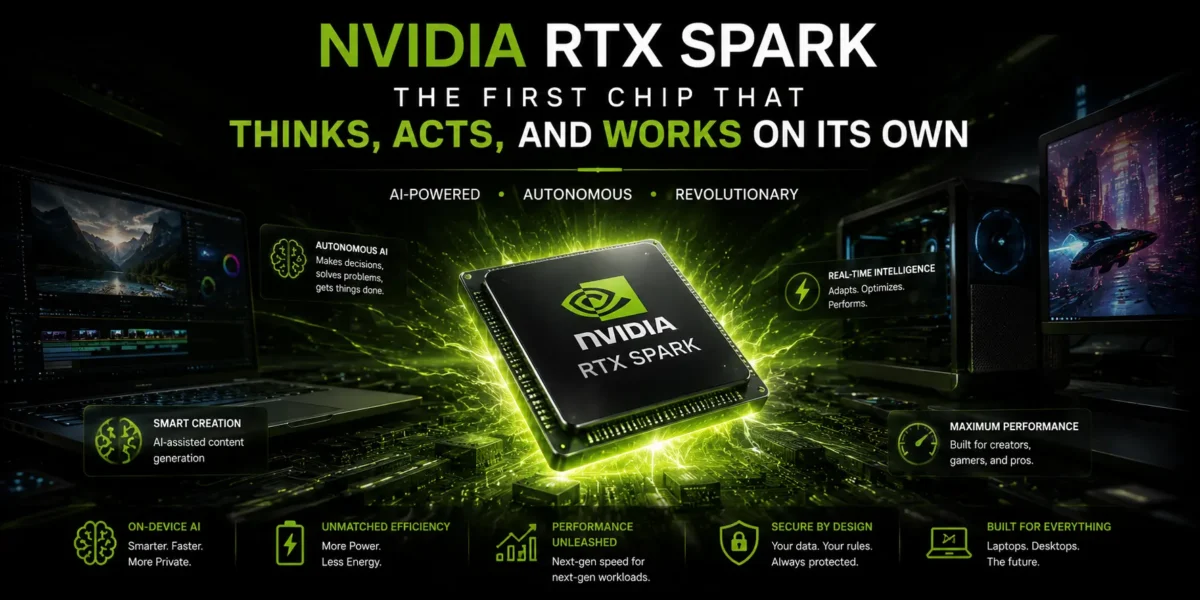
Nvidia RTX Spark is two things at once: a new computer chip, and a new class of Windows laptops and small desktops built around it. The chip is what Nvidia calls a superchip, meaning it combines a powerful graphics processor (GPU) and a main processor (CPU) into one tightly linked package. The GPU side comes from Nvidia’s latest Blackwell design. The CPU side, with 20 cores, was co-designed with MediaTek, a major Taiwanese chipmaker.
The most important detail is hidden in plain sight. This chip is built on Arm architecture, the same family of designs that powers your smartphone and Apple’s modern Macs, rather than the older x86 standard that Intel and AMD have used in Windows PCs for decades. That one choice is the earthquake under the whole announcement, and we will return to why it rattled the entire industry.
Nvidia CEO Jensen Huang summed up the goal in five words on stage: “The PC is being reinvented.” The pitch is that your computer stops being a tool you operate and becomes a teammate that works alongside you.
Nvidia RTX Spark Specs Explained in Plain Words
The official numbers sound like science fiction, so here is what each one actually means for a normal person.
1 Petaflop of AI performance. A petaflop is a measure of raw calculating speed. One petaflop is a thousand trillion operations per second. Until recently, that level of power lived only inside data centers that fill entire rooms. RTX Spark squeezes it into a laptop. In simple terms, it means the machine can run heavy AI on its own without phoning a server for help.
Up to 128GB of unified memory. Memory is your computer’s short-term workspace. Most laptops today have 16GB or 32GB. Unified memory means the GPU and CPU share one big pool instead of splitting it, so the machine can hold very large AI models and huge files open at the same time. 128GB is a workstation-class amount, and it is what lets the laptop run serious AI locally.
Runs a 120-billion-parameter model with a 1 million token context. A large AI model has billions of internal settings called parameters; more parameters generally means a smarter, more capable model. “Context” is how much information the AI can keep in mind at once. A 1 million token context is enough to read an entire long book, or thousands of pages of your own documents, in a single go. Running this on your device, not the cloud, is the headline feat.
The creative and gaming numbers. Nvidia says one machine can edit 12K video (sharper than 4K), build enormous 3D scenes, generate 4K AI video, and still play modern games at 1440p resolution above 100 frames per second, which means smooth, high-quality gameplay.
All of this fits in a laptop as thin as 14 millimeters and as light as about 1.4 kilograms (three pounds), with all-day battery life and a high-quality OLED screen.
What Are AI Agents, and What Can RTX Spark Actually Do for You?
The phrase doing the heavy lifting here is AI agent, so it is worth being clear. Most people’s experience of AI so far is a chatbot: you type a question, it types an answer, the conversation ends. An agent is different. It is AI that can take a goal and carry out the multiple steps to finish it on its own, working across your apps without you clicking through every step.
Here is what that looks like in everyday life on an RTX Spark machine:
- You say “clean up and reply to my inbox,” and the agent sorts your email, drafts replies in your style, and flags only the messages that truly need you.
- You hand it a folder of raw clips and say “make me a two-minute highlight reel,” and it edits the video while you do something else.
- You ask it to “find every contract that mentions a refund clause,” and it reads through years of your own files and pulls the answers, all without uploading anything to the internet.
- You give it a research task or a coding task and it works through it step by step, like an assistant rather than a search box.
The reason this needed new hardware is trust and power. Until now, running a capable agent meant sending your private data to the cloud and paying a monthly fee. RTX Spark is powerful enough to run agents on your own device, and Microsoft and Nvidia added a safety layer (new Windows security controls plus an Nvidia system called OpenShell) that lets you decide exactly what an agent is allowed to touch, keeps sensitive data on the device, and can hide personal details before anything is ever sent online. Microsoft CEO Satya Nadella framed the ambition as bringing this kind of intelligence to every home and desk through Windows.
RTX Spark vs MacBook, Copilot+ PC, and ChatGPT: How is it different?
This is the question most buyers actually have, so here is the straight comparison.
Versus a regular laptop or a MacBook: A normal laptop, even a fast MacBook, is built mainly to run apps quickly. RTX Spark is built to run AI agents locally, with the giant memory pool and AI speed needed to do it. Apple’s chips are also Arm-based and very efficient, but Apple does not yet offer this kind of agent-first Windows experience with 128GB unified memory aimed at this workload.
Versus a Copilot+ PC (the AI PCs already on sale): Today’s Copilot+ laptops, many powered by Qualcomm Snapdragon chips, can handle light AI tasks on device. RTX Spark is a much bigger jump in raw power, enough to run large models that those machines have to send to the cloud.
Versus ChatGPT or other cloud AI: When you use ChatGPT, your request goes to a company’s servers. RTX Spark’s whole point is doing that work on your own machine, which means more privacy, no per-use fees for local tasks, and answers even without a strong internet connection.
Will My Apps Work on RTX Spark? the Windows on Arm Question
This is the honest catch. Because RTX Spark uses Arm rather than x86, some older Windows programs may not run perfectly, an issue that has bothered Windows-on-Arm laptops for years. The encouraging sign is that big software makers are backing it early. Adobe is rebuilding Photoshop and Premiere from scratch for the platform, promising up to twice the speed and committing to native Arm versions, something rivals chased for two years without success. More than 100 software and game companies, including Blender, CapCut, Riot Games, and Xbox, are on board. Even so, if you depend on a niche or older program, it is worth checking compatibility before buying.
Nvidia RTX Spark Price and Release Date
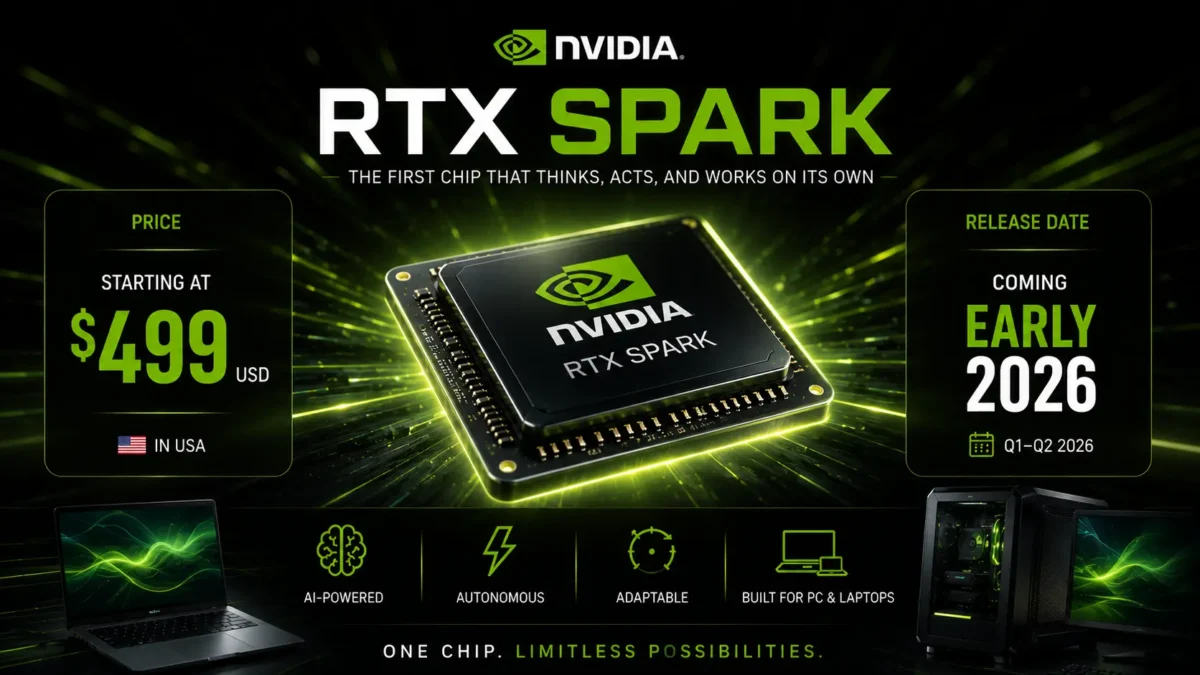
So what will it cost? Nvidia has signaled that RTX Spark laptops will start around 1,299 dollars and rise toward 2,499 dollars for premium models. For Indian readers that is roughly 1.1 lakh to 2.1 lakh rupees at current exchange rates, before any local taxes, import duties, or official India pricing, which has not been announced. These are premium machines, which is exactly where new computing categories usually start before getting cheaper.
On timing, RTX Spark laptops and compact desktops are due this fall (late 2026) from ASUS, Dell, HP, Lenovo, Microsoft Surface, and MSI, with Acer and GIGABYTE to follow. Microsoft’s own Surface Laptop Ultra is expected to be among the first, which is why you may have seen it in the news right next to the chip.
Why Nvidia and Arm Stock Went Up While Intel Got Nervous
The stock market read the stakes within hours. Nvidia shares rose about 6 percent, lifting its value to roughly 5.47 trillion dollars. The single biggest winner was Arm Holdings, up somewhere between 15 and 18 percent, because RTX Spark is built on Arm, so Arm collects a royalty on every machine sold.
The losers told the rest of the story. Qualcomm, whose Snapdragon chips lead today’s Windows-on-Arm laptops, fell around 7 percent because Nvidia is moving into the exact same space with far more brand power. Intel slid as much as 6 percent and AMD dipped too, because RTX Spark is a direct attack on the x86 standard they have dominated for decades. One Intel executive admitted the company is watching Nvidia with what he called a healthy dose of paranoia.
There are real risks. Demand for AI PCs has not been proven at scale yet, the research firm IDC expects global PC shipments to actually fall in 2026 because of memory shortages and rising costs, and the app-compatibility issue is genuine. Whether RTX Spark succeeds may depend less on its power and more on whether ordinary people decide they want an on-device agent at all.
Should You Buy an RTX Spark Laptop?
Strip away the jargon and the stock charts, and the real question is: should you care, and should you wait?
If you are a creator, developer, or gamer who already pushes a machine to its limits, RTX Spark is aimed straight at you, and the fall lineup is worth watching. If you are a more casual user, patience is the smarter play. First-generation hardware in a brand-new category is always priced high and always improves fast, so a second wave will likely be cheaper and more polished. But the direction is now set. Within a few years, a computer that simply waits for your commands may feel as dated as a phone with physical buttons.
The PC has been fundamentally the same machine since most of us first touched one. RTX Spark is the clearest sign yet that the next version of it will not just respond to you. It will work for you.
Frequently Asked Questions
Q1. What is Nvidia RTX Spark?
A new Nvidia superchip and a new class of Windows PCs, co-developed with Microsoft, built to run AI agents directly on your device instead of in the cloud.
Q2. When is the RTX Spark release date?
This fall (late 2026), from ASUS, Dell, HP, Lenovo, Microsoft Surface, and MSI, with Acer and GIGABYTE following.
Q3. How much does RTX Spark cost?
Around 1,299 dollars to start, rising to about 2,499 dollars for premium models, roughly 1.1 to 2.1 lakh rupees before local taxes and duties.
Q4. What is an AI agent?
Software that takes a goal and completes the multiple steps to finish it on its own, working across your apps, rather than just answering one question like a chatbot.
Q5. Will my Windows apps work on RTX Spark?
Most modern apps will, and major software is being rebuilt for it, but because it uses Arm chips, some older or niche programs may need checking first.
Q6. Why did Nvidia and Arm stock go up?
Investors saw RTX Spark as a major push into personal computers, and because the chip is Arm-based, Arm earns a royalty on every unit sold.