
Table of Contents
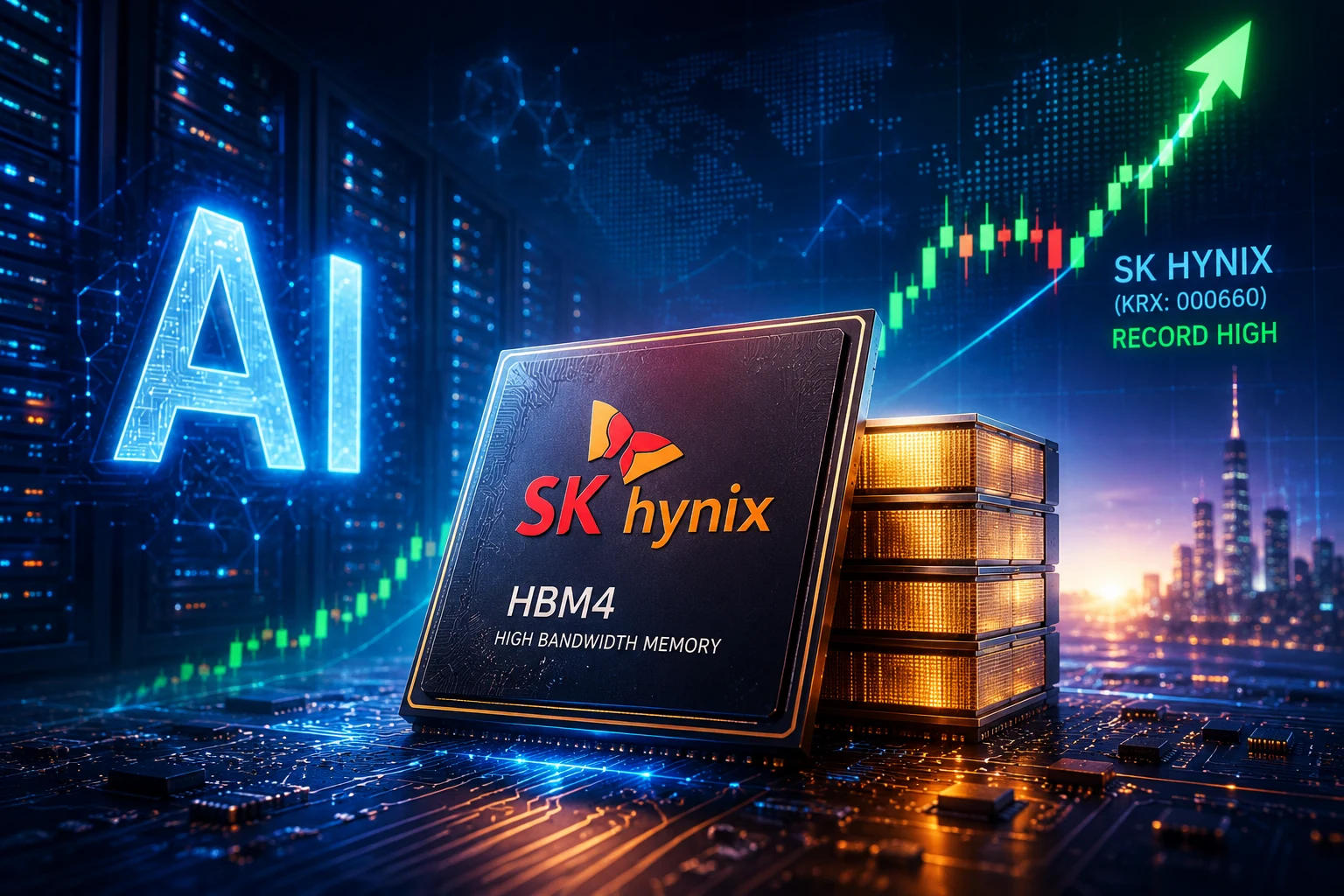
SK Hynix Inc. (KRX: 000660) has emerged as one of the most watched semiconductor stocks globally in 2026, with shares surging to all-time highs on the back of explosive demand for High Bandwidth Memory (HBM) chips – the critical hardware powering the world’s AI infrastructure.
The South Korean memory giant’s stock recently traded around ₩1,835,000 KRW, capping a rally that has tripled the company’s revenue year-over-year and drawn analyst consensus firmly into “Buy” territory. With average price targets ranging from ₩1,817,000 to ₩1,880,000 – and some estimates stretching past ₩1,988,000 – Wall Street’s appetite for AI memory exposure shows no sign of cooling.
Record Earnings Signal a New Era for Memory Chips
SK Hynix’s first-quarter 2026 earnings underscored just how dramatically AI has reshaped the memory industry.
The company reported total sales of ₩52.6 trillion – roughly three times the figure from the same quarter a year earlier. Operating profit hit ₩37.6 trillion, translating to a staggering 72% profit margin that would be the envy of most software companies, let alone a hardware manufacturer.
The numbers reflect a supply-demand imbalance that has tilted overwhelmingly in SK Hynix’s favor. According to TrendForce, average DRAM prices – inclusive of HBM – rose 50% to 55% in early 2026 compared to Q4 2025, driven by AI workloads consuming upstream production faster than manufacturers can scale.
HBM: The Chip Behind the AI Boom
At the center of this rally is HBM – High Bandwidth Memory – the ultra-fast memory modules embedded inside AI accelerators and data center GPUs manufactured by Nvidia, AMD, and Google.
Every large language model trained, every AI inference workload processed, and every generative AI application deployed relies on HBM to move data at speeds conventional memory cannot match. SK Hynix controls an estimated 50% to 62% of the global HBM market, according to Counterpoint Research data, making it the single largest supplier of what has become the most strategically important component in AI hardware.
Critically, the company has sold out its entire HBM production for 2026 – a development that has locked in revenue visibility and given management unusual pricing leverage heading into the second half of the year.
The Nvidia Connection: Vera Rubin and HBM4
SK Hynix’s dominance is inextricable from its relationship with Nvidia, the world’s largest AI chip company. SK Hynix already holds roughly two-thirds of Nvidia’s 2026 HBM4 allocation for the upcoming Vera Rubin AI accelerator platform, slated for commercial availability in the second half of this year.
With Nvidia projecting nearly $1 trillion in chip orders through 2027, and its GPU roadmap extending through Rubin, Rubin Ultra, and Feynman architectures, the memory requirements feeding into each successive generation are growing exponentially.
SK Hynix has positioned itself accordingly. At GTC 2026, the company’s leadership declared that “memory is transcending its role as a mere component to become a core element that determines the architecture and performance of the entire AI infrastructure.”
That framing is not hyperbolic. Modern AI data centers are fundamentally memory-bound – whoever controls the HBM supply controls the bottleneck of the entire AI hardware stack.
$13 Billion Bet on Long-Term Dominance
In January, SK Hynix announced a $13 billion investment (19 trillion won) to construct a new advanced semiconductor packaging and testing facility – designated P&T7 – in the Cheongju Techno Polis industrial complex in South Korea.
The move is offensive, not defensive. Industry projections forecast the global HBM market to expand at a 33% compound annual growth rate from 2025 to 2030, and SK Hynix is building the physical capacity to capture the majority of that growth.
The company is simultaneously developing HBM4, its next-generation memory product, ensuring it maintains its technological lead as AI workloads scale into multi-trillion-parameter model territory.
Samsung and Micron Intensify the Race
SK Hynix does not operate unchallenged.
Samsung Electronics unveiled its HBM4E memory chips at GTC 2026, delivering 4.0 TB/s bandwidth at 16 Gbps per pin – a significant performance leap. Samsung has pledged to triple its HBM production capacity and has begun shipping HBM4 memory for AI systems, with per-pin speeds of 11.7 Gbps that exceed the 8 Gbps industry baseline.
Micron Technology, the U.S.-based competitor holding approximately 11% of the HBM market, is also ramping production and has received price target boosts from analysts at Mizuho who see sustained chip demand ahead.
AMD’s leadership recently visited Samsung’s chip fabrication plants – a signal that the competition for AI memory supply partnerships is becoming a multi-front contest that extends well beyond Nvidia’s orbit.
The risk for investors: if all three companies ramp production simultaneously, oversupply could eventually compress the margins that have made SK Hynix so profitable. Memory markets have historically been cyclical and boom-bust dynamics remain the sector’s defining vulnerability.
For now, however, demand far outstrips supply, and analysts do not expect that equation to shift before 2027 at the earliest.
A U.S. Listing Could Unlock the Next Catalyst
One development worth watching closely: SK Hynix has signaled plans to list shares in the United States, which would give American institutional and retail investors direct access to the stock for the first time without navigating Korean exchange mechanics.
A U.S. listing could trigger a significant re-rating, broadening the investor base and increasing liquidity at a moment when AI-adjacent equities command premium valuations on American exchanges.
The Bottom Line
SK Hynix is not merely benefiting from the AI boom – it is manufacturing the physical infrastructure that makes the boom possible. With a 72% profit margin, dominant HBM market share, sold-out production, a deep strategic partnership with Nvidia, and $13 billion in fresh capital expenditure, the company has assembled a position that few competitors can replicate in the near term.
The stock carries real risks – cyclicality, rising competition, and the possibility of an eventual supply glut chief among them. But for now, the AI memory market belongs to SK Hynix, and the market is pricing that reality accordingly.