
What Is ChatGBT?
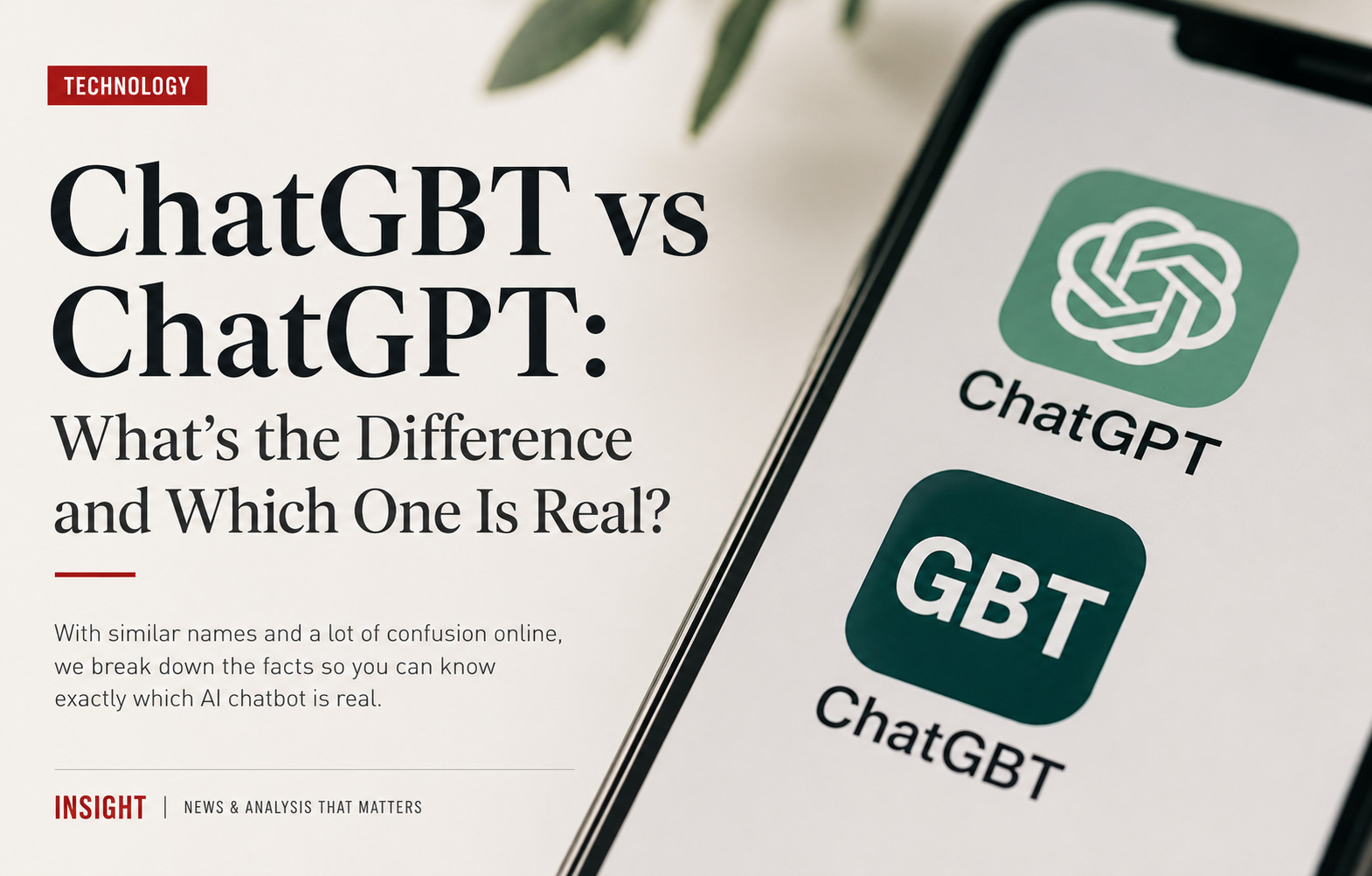
ChatGBT is not an officially released AI product. No company, no lab, and no developer has launched a tool under this name. The term exists almost entirely as a misspelling of ChatGPT, where the letter P gets swapped for a B, either through fast typing, autocorrect on a phone, or hearing the name spoken aloud before ever seeing it written. Since P and B sound nearly identical in casual speech, millions of people genuinely believe they are searching for something real when they type ChatGBT.
However, the reason this comparison article exists and the reason it matters is that a huge number of people who search for “ChatGBT vs ChatGPT” are not just looking for a spelling correction. They want to know what ChatGPT actually is, what it does, how it works, whether it is free, and whether it is worth using. That is exactly what this article covers, thoroughly and from scratch.
What Is ChatGPT?
ChatGPT is an AI assistant developed by OpenAI, a technology company founded in San Francisco in 2015. It launched publicly on November 30, 2022 and became the fastest growing consumer technology product in history, reaching 100 million users in just two months. As of 2026, it has 900 million weekly active users and processes 2.5 billion requests every single day. For context, Google handles around 8.5 billion searches daily, which means ChatGPT is already handling nearly 30 percent of that volume, and it did not exist three years ago.
The name ChatGPT stands for Chat Generative Pre-trained Transformer. Breaking that down:
Chat means it is designed for conversation. You talk to it like you would message a person.
Generative means it creates original responses rather than pulling pre-written answers from a database. Every reply is freshly produced.
Pre-trained means OpenAI trained it on enormous amounts of text before releasing it to the public, so it already understands language, context, and a vast range of topics.
Transformer refers to the neural network architecture that powers it, the same foundational technology behind most modern AI systems.
The result is a tool that understands what you ask in plain language and responds with something genuinely useful, whether you are asking a simple question, requesting help with a task, or working through a complex problem.
ChatGBT vs ChatGPT: The Core Differences
Since this is a comparison, here is the direct side by side breakdown across every dimension that matters.
Existence and Origin
| Difference | ChatGBT | ChatGPT |
|---|---|---|
| Real product? | No official release | Yes, launched November 2022 |
| Developer | None verified | OpenAI |
| Available today? | No | Yes, free at chatgpt.com |
| Weekly active users | Zero | 900 million |
What They Can Do
ChatGPT in 2026 is far more than a chatbot. It is a full platform with multiple capabilities running in a single interface. Here is what it can actually do.
Writing and editing means you can draft emails, blog posts, essays, social media captions, cover letters, product descriptions, reports, scripts, and more. It can also edit and rewrite content you have already written, improving grammar, tone, clarity, and structure on demand.
Research and explanation means you can ask it to explain anything in plain language. Medical terms, legal concepts, historical events, financial instruments, scientific principles. It adjusts the complexity of its explanation based on how you ask, so a 12-year-old and a PhD student can both get useful answers to the same question.
Coding and development means ChatGPT writes, debugs, and explains code across dozens of programming languages. Developers use it to build features, fix bugs, review logic, and generate documentation. In 2026, OpenAI added Codex, a dedicated coding agent that can handle entire software development workflows.
Image generation means through built-in DALL-E integration, ChatGPT generates images from text descriptions. You describe what you want to see and it produces it, with the ability to refine through follow-up messages rather than starting from scratch each time.
Deep Research is available on paid plans and lets ChatGPT conduct multi-source research across the web, synthesise findings, and produce structured reports on complex topics in minutes rather than hours.
Voice and audio means ChatGPT supports advanced voice mode where you speak your queries and receive spoken responses, making it usable hands-free and accessible to people who find typing difficult.
Data analysis means you can upload a spreadsheet, a PDF, or a data file and ask ChatGPT questions about it in plain language. It runs analysis, produces charts, and summarises findings without requiring any technical knowledge from the user.
Translation means ChatGPT translates between dozens of languages with strong contextual accuracy, handling documents, conversations, and individual phrases.
Memory means on paid plans, ChatGPT remembers information about you across conversations, so it can personalise its responses over time based on your preferences, work, and previous interactions.
ChatGBT, being a non-existent product, can do none of these things.
ChatGPT Models: What Has Changed in 2026
One reason this comparison matters now more than ever is that ChatGPT in 2026 is a fundamentally different product from what most people remember hearing about in 2022 or 2023.
The original ChatGPT ran on GPT-3.5. Then came GPT-4 in March 2023, GPT-4o in May 2024, and GPT-5 in August 2025. As of April 2026, the current flagship is GPT-5.5, which handles text, images, audio, reasoning, and agentic tasks within a single unified system.
What this means practically is that the free version of ChatGPT in 2026 is more capable than the paid version was just two years ago. Free users now get GPT-5.3 Instant as their default model, which handles writing, research, explanation, and general tasks at a level that would have required a paid subscription in 2023.
ChatGPT Pricing: Free vs Paid
This is one of the most important things to understand if you are new to ChatGPT.
Free ($0/month) gives you access with your email, GPT-5.3 Instant, text conversations, basic web search, and limited image generation. More than sufficient for casual daily use. There are usage caps and ads in some regions but the core experience is genuinely useful at no cost.
Go ($8/month) offers higher usage volume than the free tier, more file uploads, and more image generation. Aimed at regular users who hit the free limits but do not need advanced features.
Plus ($20/month) is the most popular paid plan. It unlocks GPT-5.5, GPT-5.5 Thinking for complex reasoning, Deep Research, Sora video generation, Codex, Agent Mode, Canvas for collaborative writing and coding, memory, and no ads. For anyone using ChatGPT professionally or daily, the time saved easily justifies the cost.
Pro ($100 or $200/month) is designed for power users and specialists. It offers 5x to 20x higher usage limits than Plus, access to GPT-5.5 Pro for the highest-capability tasks, and unlimited access to the most demanding features. Relevant for researchers, engineers, and heavy professional users.
Business ($20 to $25/user/month) is for teams. It adds admin controls, collaboration features, integrations with Slack, Google Drive and GitHub, and guarantees that company data is not used for AI training.
Who Should Use ChatGPT and Why
Students use it to understand difficult concepts, get feedback on writing, prepare for exams, and work through problems step by step at their own pace without feeling embarrassed to ask basic questions.
Professionals use it to draft communications faster, summarise long documents, prepare for meetings, and handle the parts of their job that involve writing or research but do not require their specific expertise.
Business owners use it to write marketing copy, respond to customer enquiries, generate content, analyse data, and handle tasks that would otherwise require hiring additional staff.
Developers use it to write code faster, spot errors, learn new languages, and work through technical problems without spending hours searching documentation.
Everyday users use it to answer questions they would previously have Googled, get recommendations, plan travel, understand confusing documents, translate content, and save time on dozens of small daily tasks.
The Honest Limitations
ChatGPT is not perfect and any honest comparison has to say so.
It makes mistakes. It can state incorrect information with complete confidence, which means you should verify facts before relying on them, especially for medical, legal, or financial decisions.
It does not have real-time knowledge by default on the free tier. Unless web search is enabled, it works from its training data which has a cutoff date.
It does not always know when it does not know something. Unlike a human expert who will say “I am not sure, check with a specialist,” ChatGPT sometimes fills gaps with plausible-sounding but inaccurate content.
Understanding these limitations does not diminish how useful it is. It just means you use it as a powerful starting tool rather than a final authority.
The Verdict
| Category | ChatGBT | ChatGPT |
|---|---|---|
| Is it real? | No | Yes |
| Free to use? | N/A | Yes |
| Writes content? | No | Yes |
| Generates images? | No | Yes |
| Translates languages? | No | Yes |
| Analyses data? | No | Yes |
| Has a mobile app? | No | Yes, iOS and Android |
| Available worldwide? | No | Yes, 160+ countries |
| Has paid plans? | No | Yes, from $8/month |
The comparison is straightforward. ChatGBT is a name people search for when they mean ChatGPT. ChatGPT is one of the most powerful and widely used tools available to ordinary people right now, it is free to start, and it works on any device.
If you came here searching for ChatGBT, you just found what you were actually looking for. Go to chatgpt.com, create a free account, and start with the question you have been sitting on. The gap between the name you typed and the tool you needed was always just one letter.